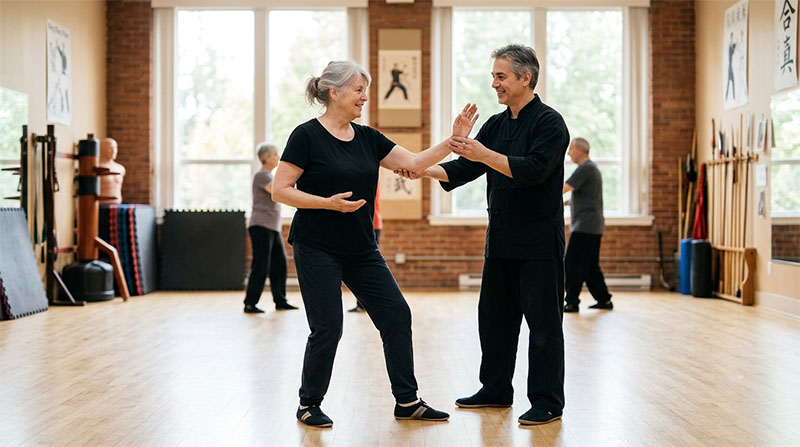
Why Wing Chun suits older learners
Many martial arts quietly assume a young, flexible, athletic body: high kicks, jumping, rolling, hard sparring. Wing Chun asks for something different. Its core ideas, the centreline, economy of motion and structure over strength, are learned through attention and patient practice. Those are qualities many older students already bring with them.
Tradition holds that the art was shaped so a smaller, physically weaker person could deal with a larger, stronger one. That same logic applies to age. You do not need to out-muscle anyone; you need good position, good structure and calm. You can read more about the ideas behind this in Wing Chun principles.
I wrote about this question directly in Is 50 too old to learn Wing Chun? The short answer is no, and in some ways it is an ideal time to start.
What the training asks of you
- No high kicks or acrobatics. Wing Chun kicks stay low, and the whole system is built on upright, grounded movement. See Wing Chun kicks.
- No ground work. You train standing, so there is no rolling or falling practice to learn the basics.
- Slow practice is correct practice. The first form, Sil Lim Tao, is done slowly by design. Speed is added later, naturally.
- A real mental challenge. Learning forms, principles and new movement patterns gives the mind plenty to work on.
The benefits students value
I am careful not to make medical promises, because every body is different. But these are the things older students most often appreciate about regular Wing Chun practice:
- Balance and body awareness. Stance work and slow forms practice teach you to feel where your weight is and how your body is aligned.
- Posture. Wing Chun trains an upright spine, relaxed shoulders and a stable base.
- Focus and calm. Many students describe slow forms practice as a moving meditation.
- Practical self-protection. Unlike purely gentle movement practices, Wing Chun also gives you genuine tools for protecting yourself. Read Wing Chun for self-defense for what that means in practice.
- Confidence. Knowing how your body works, and how to use it, carries into everyday life.
See your doctor first. Before starting any new exercise programme, talk to your doctor, especially if you have heart or blood pressure concerns, osteoporosis, joint replacements, balance problems, diabetes, or are recovering from an injury or surgery. Ask whether there are movements you should modify or avoid, and check in again if your health changes. Nothing on this page is medical advice.
Safety guidelines for training at home
- Train on a clear, non-slip floor with good lighting and room to move.
- Keep a sturdy chair or counter within reach for balance in the early weeks.
- Wear flat, supportive shoes, or train barefoot on a safe floor if that suits you. See what to wear for Wing Chun.
- Warm up every time and cool down afterwards.
- Stay hydrated and rest whenever you need to.
- Stop if you feel pain, dizziness, chest discomfort or unusual shortness of breath. Discomfort is a signal, not a challenge.
How to adapt your training
One of the reasons I enjoy teaching older students is how easily Wing Chun can be adjusted without losing its essence. The principles stay the same; only the intensity changes.
A higher, more comfortable stance
The Wing Chun stance has a slight bend at the knees. If your knees or hips are sensitive, stand a little taller. A higher stance still teaches alignment and balance, and you can sink a little lower as your legs strengthen, or not at all if your body prefers. In the Traditional Wing Chun I teach, the feet are not turned in, which many students find comfortable on the knees. My post on Wing Chun stances explains more.
Shorter sessions, more often
Instead of one long session, try two or three sessions of about ten minutes spread across the day. Consistency matters far more than intensity. Short, regular practice keeps you moving, avoids fatigue and builds a lasting habit.
Seated practice on difficult days
Many hand movements of Sil Lim Tao can be practised while seated. On days when standing is hard, you can still work on Tan Sao, Wu Sao and Fook Sao, keeping your elbows relaxed and your hands on the centreline. See Wing Chun hand techniques.
Gentle punching
Practise chain punching in the air, slowly and relaxed, before any contact work. If you later add a wall bag, keep it well padded and let the wrists, elbows and shoulders adapt over weeks rather than days.
Footwork at your own pace
Stepping and turning come in with the second form, Chum Kiu. Learn the steps slowly, near a wall or chair at first, and keep them small. Never cross your feet; that rule also keeps you balanced.
Partner work by agreement
If you train with a partner, agree on gentle pressure and a clear signal to stop. Cooperative drills such as early Chi Sao rolling build sensitivity without hard impact. The protective gear guide covers what is worth wearing when contact increases.
Try this: a gentle 20-minute session
- Warm-up (5 minutes): slow neck turns, shoulder rolls, wrist and ankle circles. My warm-up exercises show a full routine.
- Balance and stance (3 to 5 minutes): hold your stance with a chair nearby, breathing calmly. Rest between holds.
- Sil Lim Tao (5 to 10 minutes): the sections you know, at a slow, comfortable pace.
- Cool-down (3 minutes): gentle stretching and a few quiet breaths.
What to expect in your first months
Everyone progresses differently, but a typical early path looks like this:
- First weeks: basic stance, guard position and the opening of Sil Lim Tao, all very gentle.
- First few months: developing structure, relaxation and the foundational hand techniques.
- Later: footwork and Chum Kiu, then simple applications and growing confidence.
Your pace is your own. The daily practice routine lesson shows how to build a habit, and conditioning for Wing Chun covers gradual strength and mobility work you can scale down.
Learning at your own pace
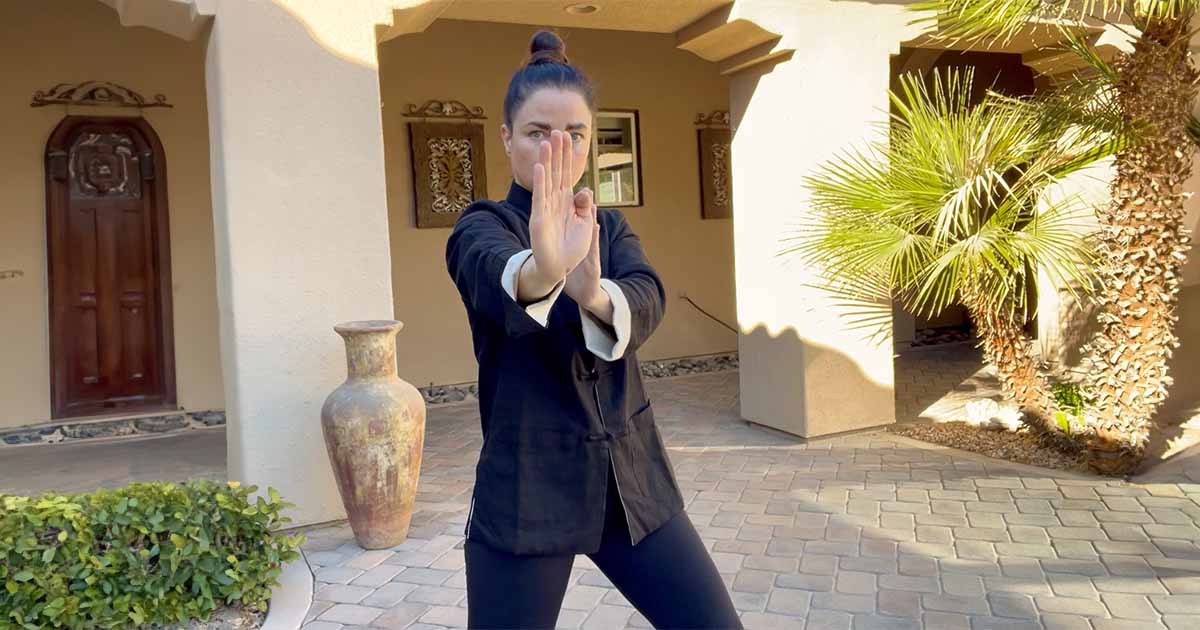
The Traditional Wing Chun I teach, as it was passed down to me by Master Brian Lewadny, who learned it from Grandmaster William Cheung, rewards patience, relaxation and correct structure far more than speed or strength. Older students often find that this suits them well.
Training at home or online also removes the pressure to keep up with anyone else. You can pause, repeat a section as many times as you like and move on only when you feel ready. My post on Wing Chun for seniors has more on safety and adaptations, and learning Wing Chun online explains what trains well at home. If you would like structured feedback as you go, my online course lets you progress level by level at your own speed.
Frequently asked questions
Am I too old to start Wing Chun?
Very rarely. Wing Chun relies on structure, relaxation and correct positioning rather than speed, flexibility or strength, so many people begin in their 50s, 60s and later. The pace of your training adapts to you. Check with your doctor first if you have any health concerns.
Do I need to be flexible or fit to begin?
No. Wing Chun has no high kicks, jumps or rolls, and its kicks stay low. The early training is slow and low-impact, and it builds fitness gradually. Start with short sessions and let your body adapt.
What if my knees or hips are sore?
Stand a little taller in your stance and shorten your holds. A higher stance still teaches alignment and balance. If pain persists or gets worse, stop and get advice from your doctor or a physiotherapist before continuing.
Will I have to spar or do heavy contact?
Not to learn the art. The forms, stance work and most hand drills are solo and non-contact. Partner work can be introduced gently and cooperatively, and you can decide how much contact suits you.
Can older adults learn Wing Chun online?
Yes, and many find it suits them well. You can train at home, at your own pace, replay lessons as often as you like and rest whenever you need to. Look for a course with a clear structure and a way to get feedback on your technique.
Next: Sil Lim Tao practice guide · beginner mistakes · Wing Chun FAQ · all lessons