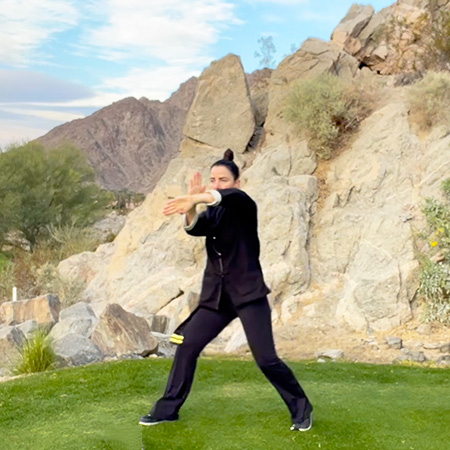
The Wing Chun approach to kicking
Wing Chun is a close-range system, and its kicks are built for that range. They are exclusively low, aimed at the knee, shin and ankle. You won't find high kicks, spinning kicks or jumping kicks in the system. That is not because Wing Chun can't kick; it is a deliberate design choice.
The reasoning is practical. A low kick is faster, because it has less distance to travel. It is harder to see, because it comes from below the opponent's line of sight while your hands are busy at eye level. And it doesn't compromise your balance the way a high kick does, so you stay rooted and ready to strike with your hands.
Kicks in Wing Chun also follow the same principles as the hands: economy of motion, the shortest path, structure over strength and simultaneous attack and defence. If you are new to those ideas, read the core principles of Wing Chun first.
Why not kick high?
Picture standing on one leg with the other at head height. For that moment, your base is narrow, your hips are open, your centerline is exposed, and if the kick is caught or misses, you are badly placed. A high kick also has to travel a long way, which gives the opponent time to see it and move.
Now picture a short kick to the shin or knee. The foot travels a short distance, your supporting leg stays under your body, your upper body stays upright and your hands stay on the centerline. If something goes wrong, you can put the foot straight back down. That is the trade Wing Chun makes: less spectacular, more reliable.
It also means Wing Chun doesn't require exceptional flexibility. What it does require is balance and structure. If you want to compare approaches, see my posts on Wing Chun vs Taekwondo and Wing Chun vs Karate.
Where kicks appear in the curriculum
In Sil Lim Tao, the feet stay planted. That stillness is deliberate: you build the stance, structure and hand techniques before adding the complication of standing on one leg.
Chum Kiu, the second form, introduces the first kicks in Wing Chun's curriculum, along with turning, stepping and the use of the whole body as one unit. It introduces three kicks in their correct Wing Chun context: the front kick, the side kick and the sweeping kick. Chum Kiu also trains one of Wing Chun's most powerful ideas: attacking and defending with hands and feet at the same time.
Kicking continues to develop in later training, including on the wooden dummy, whose leg gives you something to step around, check against and kick toward at the right height and angle. The exact kicks and their order in the forms and dummy form differ between lineages, so I won't try to list every one here. Learn them in the order your Sifu teaches.
The three Chum Kiu kicks: purpose first
Kicking mechanics are very hard to learn from text, and small details such as the striking surface, the angle of the foot and how the supporting leg is placed vary between lineages. So instead of a step-by-step that might contradict what your instructor shows you, here is what each kick is for and what to look for.
Front kick
Purpose: a short, straight kick toward a low target in front of you, travelling along the centerline. It follows the same logic as the punch: the shortest path to the target. It can stop an opponent who is stepping in, or strike as your hands control their arms.
Look for: the knee lifting no higher than needed, the kick travelling straight rather than swinging, the upper body staying upright and the hands staying on the centerline.
Side kick
Purpose: a low kick delivered with the body turned, useful when you have stepped or pivoted to an angle and the target is to your side, such as the opponent's knee from the outside.
Look for: a connected turn so the whole body is behind the kick, the supporting leg stable, and no leaning away from the target to lift the leg.
Sweeping kick
Purpose: a low kick that sweeps or disrupts the opponent's leg or foot, breaking their base and balance rather than striking hard.
Look for: staying low and balanced throughout, and keeping the hands active so the sweep and the hands work together.
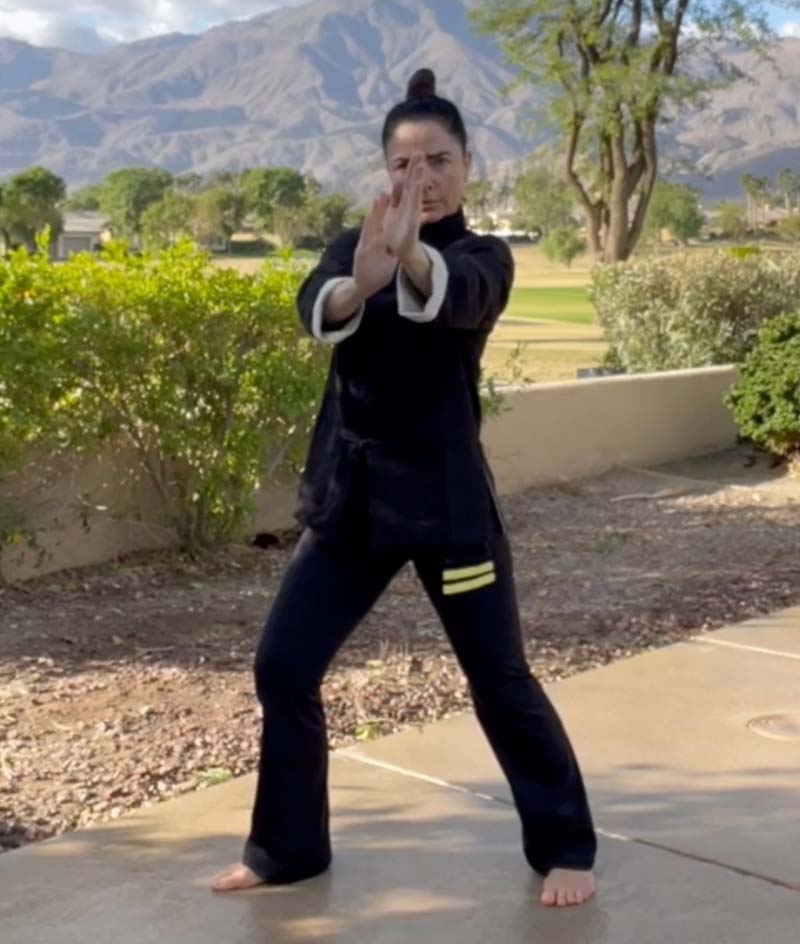
Kicking principles to train from day one
- Stance first. If your stance isn't properly rooted, the kicks will compromise your balance. Every weakness in Sil Lim Tao becomes more obvious once you start kicking in Chum Kiu.
- Stay upright. Your spine stays vertical. Leaning back to lift the leg breaks structure and pulls your hands off the centerline.
- Keep the hands working. The hands guard and strike while the foot kicks. Don't drop them to help your balance.
- Short and direct. No big chambers or wind-ups. The kick goes out and comes back by the shortest path.
- Return to a stable base. After a kick, the foot comes back down where you can use it, ready for the next step.
- Kick from footwork. Kicks are usually combined with stepping and turning. Triangle stepping and the pivot put you at an angle where a low kick is available. My post on Wing Chun footwork explains these.
Drills for balance and kicking
Drill 1: One-leg stance hold
Stand next to a wall or sturdy chair. From your stance, transfer your weight to one leg and lift the other foot just off the floor. Keep your spine upright and your guard on the centerline. Hold for ten to twenty seconds, then switch. Three times each side. Touch the wall if you need to.
Drill 2: Slow knee lift
From the same position, lift the knee slowly to a low height, pause, and lower it without the foot slapping down. Watch in a mirror that your upper body doesn't lean or twist. Five per side.
Drill 3: Slow kicks in the air
Practise the Chum Kiu kicks exactly as your instructor has shown you, very slowly, to a low target height in the air. Three to five per side for each kick, pausing at full extension to check balance and hand position.
Drill 4: Hands and feet together
Once the kicks are stable, add a simultaneous hand technique: for example, a slow front kick with a punch, or a kick while your hands hold Tan Sao and Wu Sao. Slow, controlled, five per side.
Drill 5: Step and kick
Place a chair as a target. Take a small angled step, turn to face it, and deliver a slow low kick toward the chair leg without touching it. Return to your stance. Five each side.
Practice plan: 12 minutes, three times a week
- Warm up ankles, knees and hips with gentle circles (3 min).
- One-leg stance holds and slow knee lifts (3 min).
- Slow Chum Kiu kicks in the air (3 min).
- Hands-and-feet combinations or step-and-kick (3 min).
Train on a non-slip surface in bare feet or flat-soled shoes; see uniform and shoes. Keep something stable within reach for balance. If you have knee, hip or balance problems, or any health condition, check with your doctor first and keep the kicks small. Never kick a partner's knees or joints at speed or with force; joints are easily injured.
Common mistakes
- Kicking too high. Keep kicks at knee and shin height.
- Leaning back. It breaks structure and pulls your hands away from the centerline.
- Dropping the hands. The hands keep guarding and striking.
- Winding up. Big chambers telegraph the kick and waste time.
- Kicking before the stance is ready. Fix your Sil Lim Tao stance first.
- Crossing the feet when stepping into a kick. Wing Chun footwork never crosses the feet.
Where to go next
Kicking ties together stance, footwork and hands, so it develops alongside the rest of your training. Keep working on the Chum Kiu practice guide, review beginner mistakes, and for how kicks fit into real situations, see Wing Chun self-defense. My post on Chum Kiu describes the form in more detail. If you want your kicking and footwork reviewed, my online course includes graded video feedback.
Frequently asked questions
Does Wing Chun have kicks?
Yes. Wing Chun kicks are deliberately low, aimed at the knee, shin and ankle. High kicks are avoided because they compromise balance and are slower than low kicks in real situations.
Which kicks are in Wing Chun?
Chum Kiu, the second form, introduces the first kicks in the curriculum: the front kick, the side kick and the sweeping kick, taught in their correct structural context. Further kicking is trained in later forms and on the wooden dummy; the details vary by lineage.
Why does Wing Chun avoid high kicks?
A high kick takes longer to arrive, is easier to see, and leaves you standing on one leg with your structure compromised. A low kick is faster, harder to see and keeps you balanced and ready to use your hands.
Do I need to be flexible to kick in Wing Chun?
No. Because the kicks stay low, Wing Chun does not require exceptional flexibility. What it does require is a stable stance, good balance and the ability to keep your upper body structured while one foot is off the ground.
Can I practise Wing Chun kicks at home?
Yes, slowly and in the air, with something stable nearby for balance at first. Practise the Chum Kiu kicks as taught by your instructor, focus on balance and structure rather than power, and never kick a partner’s knee or joints at speed.
Next: Chum Kiu practice guide · the Wing Chun punch · partner drills · all lessons