Why principles come before techniques
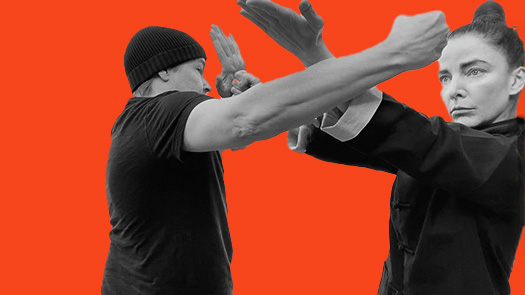
When students first see Wing Chun, they notice the hand shapes: Tan Sao, Bong Sao, Pak Sao, the chain punch. Those matter, but each one is really a principle in physical form. If you understand why a Tan Sao sits where it does, you can fix it yourself. If you only memorise its shape, it will fall apart the moment someone pushes on it.
That is why the first form, Sil Lim Tao, is often translated as "a little idea". It trains ideas before it trains fighting. The principles below are the ones I come back to in every lesson, from a student's first week to master level. Read them, try each drill slowly, and then see how they show up in the other free lessons, such as centerline theory, hand techniques and the Wing Chun punch.
1. The centreline
Picture a vertical line running from the top of your head down through the middle of your body. Your opponent has one too. The most vulnerable targets sit on or near that line: the eyes, nose, throat, solar plexus and groin. Wing Chun techniques are built to protect your own centreline while attacking your opponent's.
Your hands either occupy the centreline, so nothing can come straight down it, or they clear it, removing whatever is in the way so you can strike. Your elbows stay down and in, close to that line. When the elbows drift outward, your techniques lose strength and your centreline opens up. This is the immovable elbow principle, and it is one of the first things I correct in beginners.
Drill: Stand in front of a mirror with your hands in a guard, both on your centreline, one in front of the other. Slowly punch with one hand, then the other. Watch that each fist travels straight along the line and that the elbow does not swing out. Ten slow punches per side. The full lesson is in Wing Chun centerline theory explained.
2. Simultaneous attack and defence
Many martial arts teach "block, then counter". Wing Chun teaches both at the same time. One hand deflects while the other strikes, or a single movement does both, as when a Tan Sao spirals forward to deflect while the other hand punches. This saves a beat, and at close range a beat is everything.
It also means you are never purely defending. Even your defensive shapes carry forward intent, so the opponent is always under pressure.
Drill: In your guard, imagine a straight punch coming at your face. Slowly perform a Pak Sao with your rear hand while your lead hand punches, so both arrive together. Reset and repeat ten times, then switch sides. Speed is not the goal; timing both hands to land together is.

3. Economy of motion
Wing Chun uses the shortest path for every technique. No wind-ups, no wide swings, no movement that does not serve a purpose. A straight punch from the centreline reaches the target sooner than a hook from the side, and a small deflection is faster to recover from than a big one.
Economy also applies to effort. If one hand can do the job, don't use two. If a small turn solves the problem, don't take a big step.
Drill: Film yourself doing five slow punches and five Tan Sao from your guard. Watch the recording. Does anything move before the hand does, like a shoulder lifting, the body leaning or the elbow pulling back first? Remove one extra movement and film again.
4. Structure over strength
Wing Chun power comes from alignment, not muscular effort. When your stance, hips, spine, shoulders and elbows are lined up, force can travel through your body into the ground, and your own power can travel from the ground into the target. That is how a smaller person can redirect a larger person's power without needing to match them.
The training stance, Yee Gee Kim Yeung Ma, exists to build this connection. In Traditional Wing Chun, as it was passed down to me by Master Brian Lewadny, who learned it from Grandmaster William Cheung, the feet are not turned inward, and when we move we lift the feet and step on angles. Some schools teach mainstream Wing Chun with a different stance and footwork; the principle of connected structure is the same. You can read more in my post on Wing Chun stances.
Drill: Hold your stance for two to three minutes, focusing on relaxation rather than rigidity. Check that your knees track over your toes, your spine is upright and your shoulders are dropped. Do three sets with a short rest between them.
5. Relaxation
Tension is slow. A tight arm can't feel what an opponent is doing, it telegraphs your intentions, and it tires you out. Raised, tight shoulders are the most common problem I see in beginners, and they disconnect your upper body from your lower body.
Relaxation does not mean floppy. Your arm can keep its shape and position while only the muscles you actually need are working. This is what lets you sense pressure in Chi Sao and respond instead of fighting force with force.
Drill: At the end of each practice, stand quietly in your stance for a few breaths. Scan from your jaw to your shoulders, elbows, hands and hips. Wherever you find tension, let it go without changing your position. Then do five slow punches keeping that same level of relaxation.
6. Forward intent
Wing Chun always has a gentle, constant intention toward the opponent's centreline. Even a deflection like Tan Sao spirals forward rather than pulling back. In the chain punch, each strike drives forward to keep continuous pressure on the opponent. In Chi Sao, forward energy means that if your partner's arm moves away, your hand naturally follows into the gap.
Forward intent is not leaning or pushing with your body weight. Your structure stays upright; the intention lives in the elbows and hands.
Drill: Stand facing a smooth wall at arm's length. Place your forearm or the back of your wrist lightly against it in a Fook Sao or Tan Sao shape. Keep a light, steady forward intention without leaning. Hold for thirty seconds, relax, switch arms. You are learning what "forward" feels like without force.
7. Facing
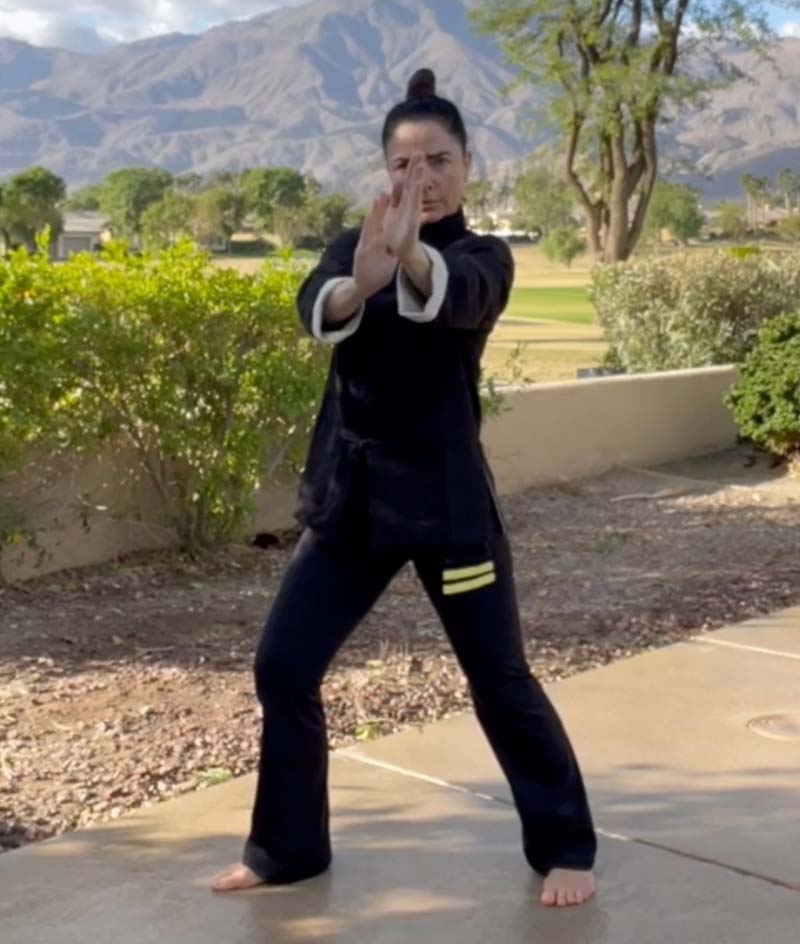
Facing means keeping your centreline pointed at your opponent so both of your hands can work. If you turn too far side-on, one hand is out of the fight. If you stand flat in front of the opponent, you are in front of both of their weapons too.
Traditional Wing Chun solves this with footwork. Instead of meeting an attack head-on, you step on an angle, often toward the outside of the opponent's lead arm (the blindside), and turn so that you are still facing their centreline while they are no longer facing yours. Grandmaster William Cheung made blindside strategy a defining feature of his system. The pivot, trained in Chum Kiu, lets you change your facing without losing structure. My post on Wing Chun footwork explains the stepping in more detail.
Drill: Place a chair in front of you as an imaginary opponent. From your stance, take one small angled step forward and to the side, then turn to face the chair again with your guard on its centreline. Never cross your feet. Five times to each side, slowly.
How the principles work together
None of these principles work alone. A punch on the centreline without structure is weak. Structure without relaxation becomes stiff. Forward intent without good facing simply walks you into the opponent's other hand. When I watch a student's form, I am really checking all seven at once: is the hand on the line, is the elbow in, is the stance connected, are the shoulders down, is there forward intention, and is the body facing the right way?
That is also why the forms matter so much. Sil Lim Tao trains the centreline, structure, relaxation and economy while standing still. Chum Kiu adds turning and stepping, so facing and forward intent can be trained while moving. Biu Jee tests whether the principles hold up when things go wrong.
Practice plan: one principle a day
- Warm-up (3 min): shoulder rolls, wrist circles, hip circles and gentle knee bends.
- Stance (3 min): one relaxed hold, checking knees, spine and shoulders.
- Principle of the day (8 min): pick one drill above and do it slowly, with full attention.
- Sil Lim Tao (8–10 min): one slow repetition, watching for the same principle throughout the form.
- Close (1 min): stand quietly and release any tension you notice.
Rotate through the seven principles across the week. If you have a health condition or an old injury, check with your doctor before starting a new training routine, and never train through sharp pain.
Common mistakes when learning the principles
- Treating them as theory. Reading about the centreline is not the same as finding it with your hands. Every principle needs a drill.
- Rushing for speed. Speed hides errors. Slow, precise repetition is how the principles get into your body.
- Confusing forward intent with leaning. Keep the spine upright. The forward energy is in the elbows and hands.
- Confusing relaxation with collapse. Relaxed arms still keep their shape and position.
- Mixing lineages. If you learn from several sources, the stance and footwork may contradict each other. Pick one approach and train it consistently. See Wing Chun lineages for background.
For more on the habits that hold beginners back, read common beginner mistakes, and for a structured week, see the daily practice routine. If you want feedback on how these principles look in your own training, my online certification course grades each level by video exam. You can also start with my overview, what is Wing Chun.
Frequently asked questions
What are the main principles of Wing Chun?
The core principles are the centreline, simultaneous attack and defence, economy of motion, structure over strength, relaxation, forward intent and facing. Every technique in the system is an expression of one or more of them.
Which principle should a beginner learn first?
Start with the centreline and structure. Together they explain where your hands go and why your stance matters, and they make every later principle easier to understand. Sil Lim Tao trains both from the very first lesson.
Do I need a partner to train Wing Chun principles?
No. Most of the principles can be built alone through the forms, stance work, slow technique repetitions and chain punching. A partner adds live pressure and timing later, especially through Chi Sao.
Is relaxation the same as being soft or weak?
No. Relaxation in Wing Chun means using only the muscles you need, so your structure carries the load and you can feel and respond quickly. A relaxed arm can still be firm in its shape and position.
Do all Wing Chun schools teach the same principles?
The core ideas are shared, but lineages express them differently, especially in footwork, stance and how they use the centreline. Some schools teach mainstream Wing Chun, others teach Traditional Wing Chun. Learn the version your Sifu teaches and practise it consistently.
Next: centerline theory · hand techniques · Wing Chun philosophy · all lessons