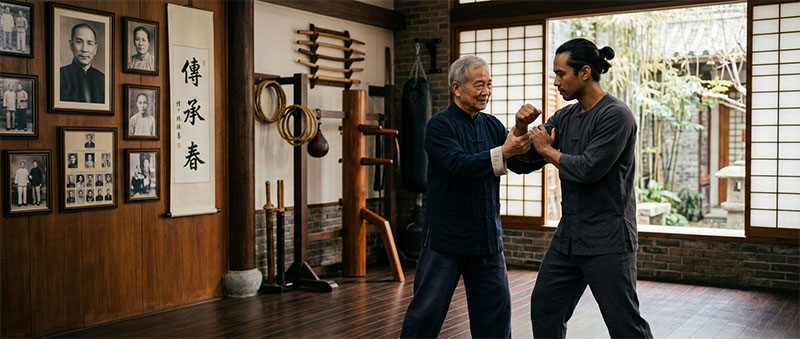
Walk into two Wing Chun schools and you may see two quite different arts. The stance is a little different, the footwork moves on different angles, the forms have different details, and the name might even be spelled Ving Tsun or WingTsun. None of that means one school is wrong. It means they come from different lineages.
This guide gives a respectful, neutral overview of the main branches, explains why lineage matters, and shows you how to verify any teacher's lineage for yourself.
Why lineage matters
Wing Chun is passed hand to hand. Much of the art lives in feel, timing and structure that a teacher corrects in person. Lineage tells you where that feel came from. It matters for three practical reasons:
- Consistency. A clear lineage usually means a complete, coherent curriculum rather than pieces gathered from videos.
- Accountability. A teacher with a traceable lineage has someone who can confirm their training and rank.
- Fit. Knowing a school's lineage helps you understand why it trains the way it does, and whether that suits you.
Kendra goes deeper in Wing Chun lineage: why it matters.
The Ip Man family tree
Ip Man (1893 to 1972) learned Wing Chun in Foshan from Chan Wah-shun and later Ng Chung-sok, and also trained with Leung Bik. After moving to Hong Kong in 1950 he began teaching publicly. His early students came largely through the Hong Kong Restaurant Workers' Association. Many of the Wing Chun schools you will find around the world today descend from the students he taught in Hong Kong. Here are some of the best-known branches, in no particular order.
Leung Sheung
Leung Sheung led the martial arts club at the Restaurant Workers' Association and was among Ip Man's earliest students in Hong Kong. Several later teachers, including Leung Ting, began their training with him.
Lok Yiu
Lok Yiu was another of Ip Man's early students in Hong Kong.
Chu Shong Tin
Chu Shong Tin (1933 to 2014) was called the "Siu Nim Tau King" by Ip Man after describing how he felt something different while practising the first form.
Wong Shun Leung
Wong Shun Leung (1935 to 1997) was known as "Gong Sau Wong", the King of Talking Hands, for his fighting reputation. He handled much of Bruce Lee's day-to-day instruction, and Lee later wrote that he had really learned his kung fu from Wong. His line uses the spelling Ving Tsun.
Grandmaster William Cheung and Traditional Wing Chun
Grandmaster William Cheung began training under Ip Man as a teenager around 1954 and lived with him as a student for several years. He later moved to Australia, opening a school in Melbourne in 1973, and became the grandmaster of the Traditional Wing Chun lineage, founding the Global Traditional Wing Chun Kung Fu Federation.
Grandmaster Cheung's teaching recognises two distinct lines of Ip Man's Wing Chun: some schools teach mainstream Wing Chun, others teach Traditional Wing Chun. The two differ in details such as stance, footwork and how the practitioner moves off the line of attack. Both come from Ip Man, and both are taught by capable instructors around the world. Kendra explains the practical differences in Traditional Wing Chun vs mainstream Wing Chun.
One well-known Traditional Wing Chun practitioner is actor Robert Downey Jr., who has trained since 2003 with Eric Oram, a student of Grandmaster Cheung since 1980. Oram has also worked as Downey's fight consultant on films including the Sherlock Holmes films and Iron Man 2. More in Robert Downey Jr. and Wing Chun.
Leung Ting and WingTsun
Leung Ting began learning at 13 under Leung Sheung and later trained under Ip Man. He founded the International WingTsun Association and chose the "WingTsun" spelling to distinguish his teaching. He has written many books on the forms; see our books guide.
Moy Yat
Moy Yat (1938 to 2001) was a student of Ip Man who moved to New York after Ip Man's death. He was also a painter and seal carver, and his books, including Wing Chun Kuen Kuit, reflect the artistic side of the tradition.
Ip Chun and Ip Ching
Ip Man's two sons both taught Wing Chun in Hong Kong. Ip Chun, the elder, was a consultant on the 2008 film Ip Man and appeared in several Ip Man films. Ip Ching (1936 to 2020), the younger son, joined his father in Hong Kong in 1962. Students who learn through the Ip family often value that direct connection to their teacher's father.
Ip Man taught many other students too, including Bruce Lee, whose story we cover in Wing Chun in film. For a wider look at well-known teachers, see Kendra's Wing Chun masters of the world.
Wing Chun families outside the Ip Man line
Ip Man was not the only master to pass Wing Chun on. Several families developed separately in southern China.
- Yuen Kay San Wing Chun. Yuen Kay San (1889 to 1956) was a well-known Foshan practitioner who combined what he learned from Fok Bo-chuen and Fung Siu-ching. His line, carried on by Sum Nung, is centred in Guangzhou, and its training includes knives, the six-and-a-half-point pole and throwing darts.
- Pan Nam Wing Chun. Pan Nam trained in Hung Ga before learning Wing Chun from Jiu Chow, whose teacher was Chan Yiu-min, son of Chan Wah-shun. He taught in Foshan from 1949. His last student, Eddie Chong, brought the system to the United States.
- Gu Lao Wing Chun. This line traces to Leung Jan, who retired to his home village of Gu Lao and taught a variation built on short drills, organised as a 40-point system.
Seeing these families helps keep things in perspective: Wing Chun has always been a family of related arts, not one fixed version.
How to verify a teacher's lineage
Whether you are joining a local club or an online course, check the teacher's lineage before you commit. It takes a few minutes and a genuine teacher will be glad you asked.
- Ask who taught them. Get their teacher's full name, where they trained, for how long and to what level.
- Ask to see certificates. Look for certificates or written recognition from their teacher or organisation, with names and dates.
- Contact the school. Reach out to the teacher's own instructor or school and ask them to confirm.
- Check with lineage associations. Many lines have an association or federation that keeps records of instructors.
- Watch them teach. Lineage tells you where knowledge came from. A trial class or sample lesson tells you whether they can pass it on.
Our checklist on what makes a good Wing Chun course covers lineage alongside structure, feedback and certification.
My lineage
Sifu Kendra Mahon
Sifu Kendra Mahon owns and publishes this site. She teaches Traditional Wing Chun as it was passed down to her by Master Brian Lewadny, who learned it from Grandmaster William Cheung. That makes her 3rd generation in the Ip Man lineage: Ip Man, then Grandmaster William Cheung, then Master Brian Lewadny, then Kendra.
She trained from 2005 to 2019 at the Canadian Wing Chun Kung Fu Academy in Calgary under Master Brian Lewadny, then completed Levels 7 to 10 in private training from 2019 to 2025, reaching the Purple Sash master level. She is recognised by Grandmaster David Cheung and is the founder of the Global Kung Fu Alliance.
She teaches the Kung Fu Kendra Wing Chun Online Certification Course. You can check her lineage the same way as anyone else's; see Kung Fu Kendra reviews, her lineage page and her recognition by Grandmaster David Cheung.
She is one of many qualified teachers. Whichever line appeals to you, use the steps above and choose the teacher who fits you best.
Frequently asked questions
What is a Wing Chun lineage?
A lineage is the chain of teachers that connects a student to earlier masters. In Wing Chun it usually runs back to Ip Man or to another Foshan-era master. Each line passes down its own details of stance, footwork, forms and training methods.
Which Wing Chun lineage is the best?
There is no single best lineage. Each major branch has produced skilled practitioners and good teachers. What matters more is the quality of the individual teacher, how clearly their lineage can be traced, and whether their teaching style suits you.
What is the difference between Wing Chun, Ving Tsun and WingTsun?
They are different romanisations of the same Chinese name. Different lines adopted different spellings, partly to tell their schools apart. Ving Tsun is used by Wong Shun Leung's line among others, and WingTsun with Leung Ting's International WingTsun Association.
How do I check a Wing Chun teacher's lineage?
Ask who taught them, for how long and to what level. Ask to see certificates or recognition from their teacher or organisation. Then confirm it yourself by contacting the teacher's own instructor, school or lineage association. A genuine teacher will welcome the question.
What is Traditional Wing Chun?
Traditional Wing Chun is the line of Grandmaster William Cheung, who trained under Ip Man in 1950s Hong Kong. Grandmaster Cheung's teaching recognises two distinct lines of Ip Man's Wing Chun: some schools teach mainstream Wing Chun, others teach Traditional Wing Chun. The two differ in details such as stance and footwork.