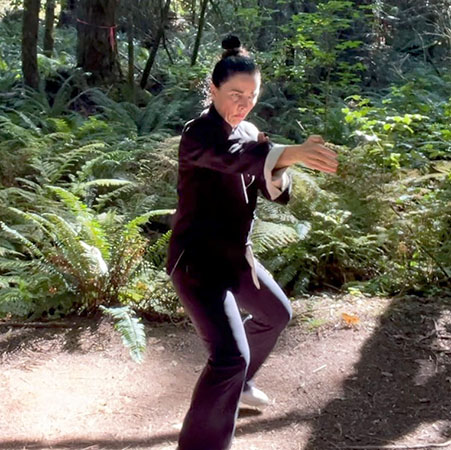
What Biu Jee is for
There is an old saying in Wing Chun: Biu Jee does not go out the door. It was traditionally the most closely guarded part of the system, taught only to advanced students who had proven their character as much as their skill. Partly that was practical, because Biu Jee contains techniques that can cause serious injury. Partly it was philosophical, because the form deals with situations where you have already lost the advantage.
I teach Biu Jee openly, because Wing Chun needs to be understood completely to be taught responsibly. What I ask in return is that you approach it with the same seriousness the traditional masters did. This is the deepest part of the empty-hand curriculum. My post What Is Biu Jee? Wing Chun's Third Form and Emergency Techniques Explained goes into the background.
Here is the simplest way to place it. Sil Lim Tao builds structure. Chum Kiu makes that structure dynamic. Biu Jee teaches what to do when your structure is compromised: when you have been grabbed, taken off balance or trapped, and the textbook response is not available.
What the form trains
As with the other forms, the exact sequence and details vary between lineages, so follow your instructor's version for the movements. For practice purposes, I find it most useful to think about Biu Jee in terms of the five things it develops:
Elbow strikes
Biu Jee develops Wing Chun's most powerful close-range striking tools. The elbow is extremely effective at close quarters, and the form trains it in several directions and applications.
Finger thrusting
The technique that gives the form its name: a penetrating finger strike to vulnerable points that a closed fist cannot easily reach. Because of where it is aimed, it is practised in the air in the form, never at a partner's eyes or throat.
Emergency recovery
How to regain your structure and centerline from a disadvantaged position.
Breaking free from grabs
Techniques for escaping grips and restraints that the standard framework does not address. These connect naturally to Wing Chun self-defense.
Long-range power generation
Biu Jee introduces a different kind of power generation that extends Wing Chun's reach beyond its normal close-range envelope.
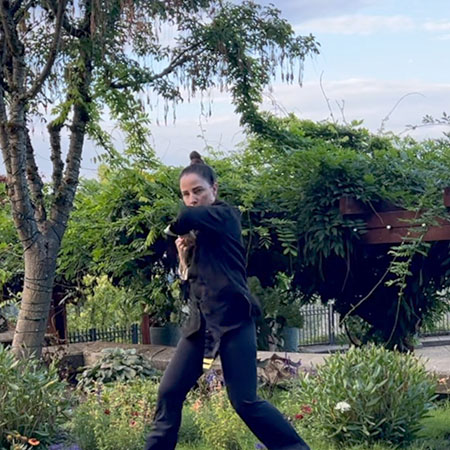
Why Biu Jee makes your whole Wing Chun better
Understanding the emergency techniques makes you more confident in your standard techniques. When you know what to do if your structure breaks down, you hold it less rigidly. When you know how to recover from a grab, you are less anxious about close contact. Biu Jee does not just add techniques; it removes the worry about what happens when things go wrong. That is a sign of maturity in your Wing Chun, and it is why the traditional masters valued the form so highly.
When you are ready for it
Biu Jee is traditionally taught after Sil Lim Tao and Chum Kiu are well established. Because many of its techniques operate outside the standard centerline framework, you need to understand that framework deeply before you can train the exceptions correctly. If your first two forms still need regular correction, that is where your practice time belongs. Your instructor should decide when you begin.
How slowly to practise
Biu Jee contains faster, more explosive movements than the first two forms, and that is exactly why you should learn it slowly. Practise one section at a time: watch the demonstration, follow along slowly, then practise the section alone before adding the next.
- Learn the shape slowly. Get each elbow, finger thrust and recovery movement correct in position before you add any speed or force.
- Keep the structure underneath. Your stance, relaxed shoulders and elbow position from Sil Lim Tao still apply. Biu Jee is not permission to get sloppy.
- Add speed last, and in control. When you do add speed, stay in control of where every strike ends. Throwing elbows or fingers to full extension at speed is how joints get strained.
Breathing
Breathe slowly and naturally, and do not hold your breath to drive the faster movements. If you find yourself bracing or holding, slow back down until breathing stays easy. As with the other forms, finish standing quietly for a few breaths and notice where you are holding tension.
How often to practise
Once you have learned it, Biu Jee becomes part of the forms you cycle through. A sensible pattern is daily Sil Lim Tao, Chum Kiu in most sessions, and Biu Jee several times a week with one clear focus each time. In a 60-minute session you can run all three forms in order, which is a good way to see how each one builds on the last. See the daily practice routine.
Practice plan: a Biu Jee session (about 20 minutes)
- Warm up wrists, fingers, elbows and shoulders (3 minutes).
- One slow Sil Lim Tao to set your structure (part of your normal daily practice).
- Biu Jee section you are working on, slowly, 3 to 5 times (8 minutes), with one focus quality.
- One full Biu Jee at a smooth, controlled pace (3 minutes).
- Record one repetition and review it with the checkpoints below.
Video checkpoints for self-correction
- Structure underneath: do you stay upright, with relaxed shoulders, while the arms work quickly?
- Elbow strikes: is the movement driven by the body, or are you swinging just the arm?
- Finger thrusts: are the fingers and wrist aligned, or does the hand bend at the wrist on extension?
- Control: does each strike stop where you intend, or do joints snap to full lock?
- Recovery: after each emergency movement, do you clearly arrive back in structure and on the centerline?
- Balance: does the stance stay stable during the more explosive movements?
- Pace: is your speed even and controlled, or do you rush the parts you find hard?
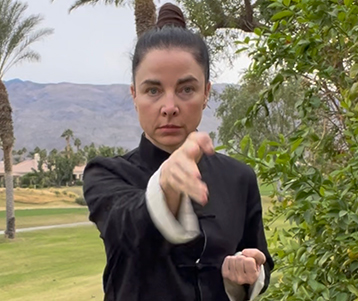
Common Biu Jee mistakes
Learning it too early
Biu Jee built on a weak Sil Lim Tao and Chum Kiu becomes a collection of flashy movements with nothing underneath.
Speed before shape
Because the form looks fast, people practise it fast. Get the positions right slowly first.
Abandoning structure
Emergency techniques are about recovering structure, not giving it up. Every movement should end with you back in a sound position.
Locking joints
Snapping elbows and fingers to full extension at speed strains them. Keep a little control at the end of every strike.
Partner practice without supervision
Finger thrusts and elbow strikes are not for casual partner practice. See the safety notes below and the partner drills lesson for how to work safely with a partner.
Safety notes
Never practise finger thrusts toward a partner's eyes or throat, and never apply grab escapes at speed or force on someone who is not trained to receive them. Warm up the fingers, wrists and elbows well, and do not attempt hand or finger conditioning on your own; that belongs under qualified instruction. If you have joint problems in the hands, wrists or elbows, or any health condition, check with your doctor before adding explosive movements. More on safe conditioning in conditioning for Wing Chun, and on protective equipment in protective gear.
After Biu Jee
With the three empty-hand forms in place, the wooden dummy and later the weapons, the butterfly swords and long pole, build on everything you have trained. Keep returning to Sil Lim Tao; it never stops revealing things. If you want structured feedback on your Biu Jee, my online course includes graded video assessment at each level.
Frequently asked questions
What does Biu Jee mean?
Biu Jee means Thrusting Fingers or Darting Fingers, after the finger-thrusting technique that is one of the form’s most distinctive features. It is the third and final empty-hand form of Wing Chun.
Why is Biu Jee called the emergency form?
Because it deals with situations where your normal structure has been disrupted: being grabbed, taken off balance or trapped. Its techniques are for recovering your structure and centerline from a disadvantaged position.
What does “Biu Jee does not go out the door” mean?
It is an old Wing Chun saying. Traditionally Biu Jee was closely guarded and taught only to advanced students who had proven their character as well as their skill, partly because some of its techniques can cause serious injury.
Can I learn Biu Jee as a beginner?
It is traditionally taught after Sil Lim Tao and Chum Kiu are well established. Because many of its techniques work outside the standard framework, you need to understand that framework first to train them correctly.
Is it safe to practise finger thrusts on a partner?
Not to the eyes, throat or other vulnerable targets. Practise finger thrusts in the air in the form. Any partner work should be slow, controlled and supervised by a qualified instructor, with targets well away from the face.
Next: daily practice routine · ranks and levels · all lessons