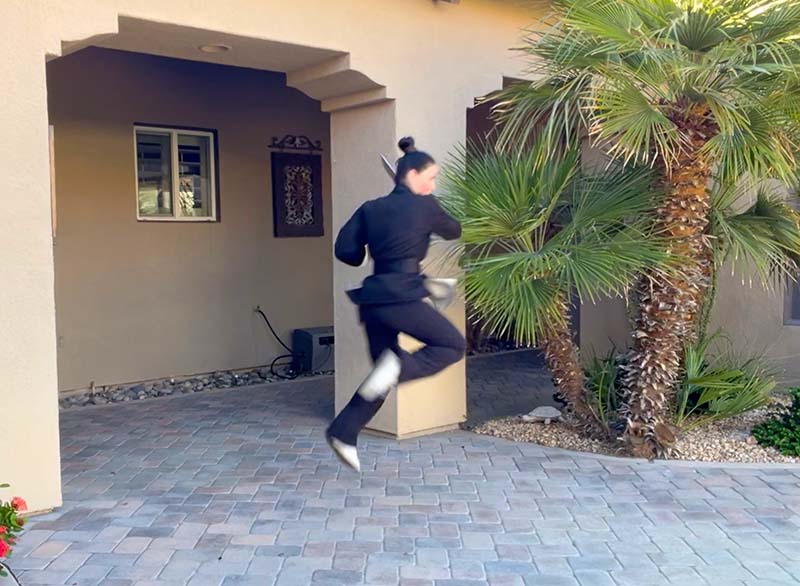
Before you buy any blade: laws on owning, buying, importing and carrying swords vary a great deal by country and region, and some rules cover blunt or decorative blades too. Check the current rules where you live. This page does not give legal advice.
What butterfly swords are
The butterfly swords, or Bart Cham Dao, are a pair of short, broad single-edged blades used together, one in each hand. They are one of the two traditional Wing Chun weapons, alongside the long pole. Each sword has a hand guard, often a D-shaped or crescent guard, that protects the hand and can be used to trap or deflect.
The sword form is usually taught late in the curriculum, after the empty-hand forms. It builds on the same structure and footwork, so buying swords before you have that foundation rarely helps. If you are not there yet, put your budget into a wall bag or ring and your home training space instead.

The three kinds of butterfly sword
Wooden and plastic trainers
Trainers are shaped like the real weapon but made of hardwood, polypropylene or similar synthetic material. They are the right first purchase for almost everyone.
- They let you learn the grip, the guard and the cutting directions without a metal edge near your body.
- They are much lighter, so you can drill the form for longer and pick up mistakes before fatigue hides them.
- Synthetic trainers flex a little and are better for any light partner contact under supervision. Wooden ones feel more solid but can splinter if they knock together hard.
The drawback is weight. A trainer won't build the wrist and forearm strength that a heavier sword demands, so most students eventually move on.
Blunt steel
Blunt steel swords have the weight and balance of a real weapon with an unsharpened edge, and often a rounded or dulled tip. They are the usual choice for solo form practice once your control is reliable. Remember that "blunt" does not mean harmless. A heavy steel blade can still cut, bruise or break bone if it lands badly, and the tip is the most dangerous part.
Sharp blades
Sharpened swords are for experienced practitioners only, and many never need them. A sharp pair adds very little to learning the form and adds a great deal of risk, plus extra legal considerations in many places. If you are considering one, discuss it with your instructor first and store it securely.
Weight
A sword that is too heavy will pull your wrists out of alignment and teach you to muscle the movements. One that is too light won't challenge your control. Look for a pair you can hold out in front of you, wrists straight, through a full run of the form without your structure collapsing. If you can't get through the form cleanly, drop back to a lighter sword. Both swords in a pair should feel the same in the hand.
Length and shape
Butterfly swords are short weapons, usually around the length of the forearm and hand. Your instructor or lineage may prefer a particular length relative to your arm. When held, the blade should feel like an extension of your forearm rather than a long sword. A very long blade will catch on your own body during turns and close-range movements.
Shapes vary between makers: some blades are broad and heavy towards the tip, others slimmer. The balance point affects how quickly the sword turns in the hand, so try to handle a pair before you buy, or choose a seller with a clear returns policy.
The guard and handle
- Guard: it should be solidly attached, smooth on the inside so it doesn't cut your knuckles, and shaped so your hand fits comfortably inside it.
- Handle: long enough for your grip, with a wrap or surface that won't twist under sweat. Loose wraps are a common fault.
- Construction: on steel swords, check that the blade is firmly fixed to the handle with no rattle or movement.
- Pair consistency: both guards and handles should match, as the form is trained with both hands working at once.
Safety when training
Most butterfly sword injuries come from turning the swords too close to your own body, or from training somewhere too cramped. A few simple habits avoid most of them.
- Clear a space wider than your full reach with both swords, in every direction you turn. Check for ceiling lights and fans.
- Learn each section slowly with trainers before you add weight or speed.
- Keep children and pets out of the room, and train with the door closed.
- Never do partner drills with steel unless a qualified instructor is supervising.
- Store steel swords out of reach, sheathed if possible, and transport them in a closed case in line with local rules.
- Check guards, handles and blades for loose parts before every session.
Learning the form
Butterfly swords reward good instruction more than good equipment. Record your form from the front and side, and compare the angles of the cuts and your footwork with your instructor's demonstration. Our guide to learning Wing Chun online covers how to get useful feedback on recordings.
Sifu Kendra Mahon explains the weapon in more depth on her own blog in Wing Chun butterfly swords (Bart Cham Dao), and teaches the form online in her butterfly swords course. Use our course checklist to judge it, or any other program, on the same terms.
Frequently asked questions
What butterfly swords should a beginner buy?
A pair of wooden or synthetic trainers. They let you learn grip, guard use and the cutting directions without the risk of a metal edge or point. Move to steel only when your instructor says your control is ready.
Are blunt steel butterfly swords safe?
Safer than sharp blades, but not safe. A blunt steel sword is still a heavy metal bar with a point, and it can injure you or a training partner. Train slowly, keep clear space around you and never do partner drills with steel unless supervised.
How long should butterfly swords be?
They are short weapons, usually roughly the length of your forearm and hand. The best guide is how the sword sits when held: it should feel like an extension of your arm rather than a long sword. Ask your instructor what your lineage prefers.
Is it legal to own butterfly swords?
It depends entirely on where you live. Laws on owning, buying, importing and carrying blades differ between countries and regions, and some apply to blunt and decorative blades too. Check the current rules for your own area before you buy or travel with any sword.
Can I learn the butterfly sword form at home?
Many students practise the form at home with trainers once they have been taught it. You need a clear space with no low ceiling fixtures, a camera to check your angles and, ideally, regular feedback from a qualified instructor.
Next: the long pole · wooden dummy guide · all gear guides