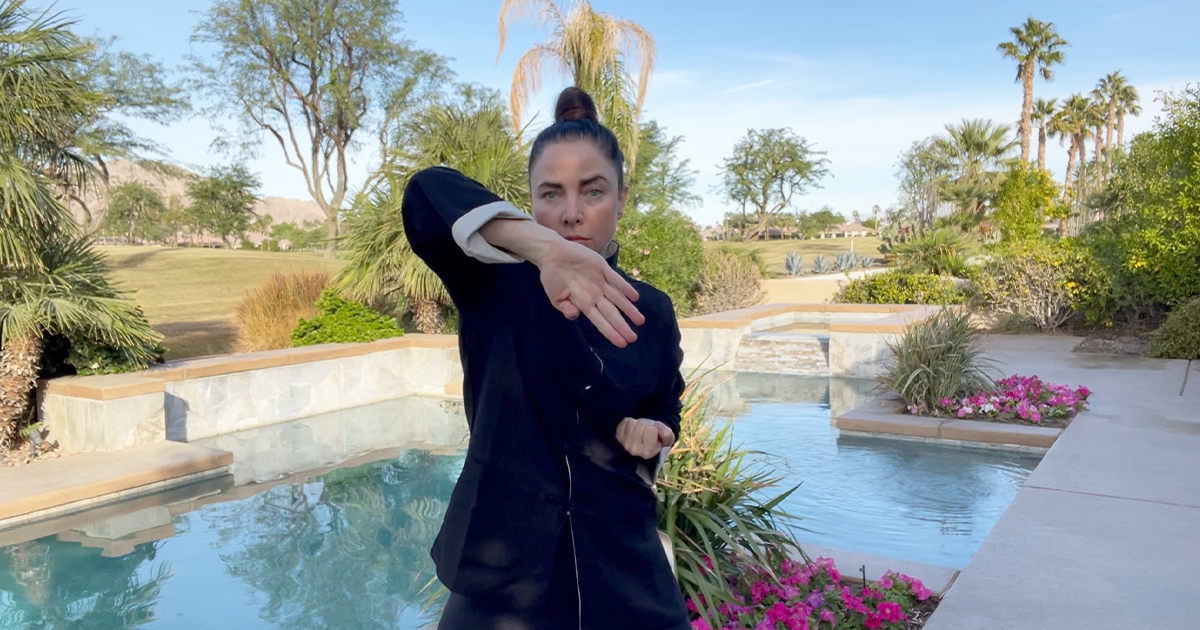
Start with what you train, not what you buy
The right space depends on where you are in your training. The first form is trained standing in one spot. Footwork, the second and third forms and partner drills need room to move. The wooden dummy and weapons need much more. Set up for the stage you are at now, and grow the space when your training actually needs it.
Whatever the level, four things make the biggest difference: a safe floor, a way to see yourself, a clear space with nothing to trip on or hit, and a routine that gets you into that space regularly.
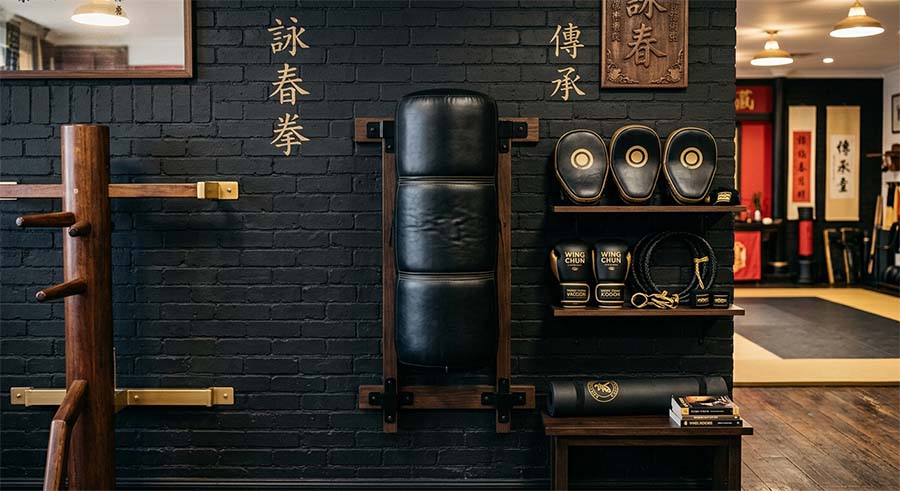
Level 1: Minimal
This is a cleared corner of a living room, bedroom or hallway. It is enough for the first form, stance work, basic hand techniques and much of the early curriculum.
- Space: enough to stand in your stance with arms fully extended and turn on the spot without touching furniture.
- Floor: whatever you have, as long as it is flat and not slippery. Move rugs that bunch up.
- Seeing yourself: a phone propped up to record, or a wardrobe or bathroom mirror.
- Extras: a Wing Chun ring needs no space at all and is a good first piece of equipment.
Plenty of students train like this for a long time. What matters most at this level is consistency: short, frequent sessions in the same place. Sifu Kendra Mahon's post on Wing Chun solo training has ideas for structuring practice on your own.
Level 2: Moderate
This is a semi-permanent area: a spare bedroom, part of a garage or basement, or a living room you clear the same way every time. It suits students working on footwork, the later forms and contact training.
- Space: enough to take several steps forward and back and to turn through a full circle with your arms out.
- Floor: firm interlocking mats or a smooth, flat surface you can pivot on.
- Mirror: a full-length mirror, fixed securely, so you can see your whole stance.
- Camera: a stable phone stand or small tripod that lives in the space, so recording takes seconds.
- Contact: a wall bag mounted on a solid wall, and focus mitts if you have a training partner.
Level 3: Dedicated room
This is a room or garage set aside for training. It makes sense once you own a wooden dummy, train weapons regularly or teach others.
- Space: room to circle a mounted wooden dummy, plus a clear line long enough for any weapons you train.
- Ceiling: high enough for weapons, with no hanging lights or fans in the way. The long pole needs the most room of all.
- Walls: solid fixing points for a dummy and wall bag, ideally on walls that don't back onto bedrooms.
- Floor: a durable, non-slip surface suitable for both footwork and dummy work.
- Storage: secure, out-of-reach storage for butterfly swords and other weapons.
- Camera: a fixed position or two, so you can record the same angles every week and compare.
Choosing a mirror
A mirror gives instant feedback on stance, centreline and hand position. A full-length mirror is best, mounted securely so it can't be knocked over. Keep a sensible distance from it and never train strikes or weapons towards it. Shatter-resistant or safety-backed mirrors are worth considering in a training space.
Mirrors have limits. You can only see yourself from the front, and looking at the mirror can pull your head and posture out of position. Use it for checks, not for every repetition.
Choosing a floor
Wing Chun footwork involves pivoting and stepping with your weight in specific places, so the floor matters more than people expect.
- Firm and flat beats soft and thick. Spongy mats make stance work unstable.
- Grip without sticking. You should be able to pivot on the balls or heels of your feet without catching. Test your surface in the shoes or socks you train in.
- Even. Mats that shift or have raised edges are trip hazards.
- Protecting the floor underneath. Under a dummy or in a garage, a thicker mat can absorb impact and protect the surface below.
Recording your form for feedback
For home students, and especially for anyone learning Wing Chun online, the camera is the single most useful piece of equipment. It lets you see what you actually do, not what you think you do, and it is how an instructor can correct you from a distance.
- Frame your whole body. Feet matter. If the camera cuts off your stance, half the information is lost.
- Use two angles. Front for centreline and symmetry; side for elbow position, stance depth and posture.
- Keep the height consistent. Around waist to chest height avoids distorted proportions.
- Light from the front. A bright window behind you turns you into a silhouette.
- Record regularly. Film the same form from the same angles every week or two and compare. Progress, and bad habits, show up clearly over time.
- Review before you resend. Watch your recording once with your instructor's notes in front of you before submitting it.
Recorded video, graded exams and instructor feedback are part of how the Kung Fu Kendra Wing Chun Online Certification Course works, and video feedback is something to look for in any online program. Our course checklist explains what good feedback looks like.
Safety in a home space
- Clear the space fully before every session: furniture corners, cables, toys and pets.
- Check the ceiling before any overhead or weapons work.
- Use solid fixings for anything that takes impact, and check them regularly.
- Keep weapons stored securely and out of children's reach.
- Warm up properly, especially in a cold garage.
For the equipment itself, see the gear guide hub, and Sifu Kendra Mahon's post on Wing Chun training equipment.
Frequently asked questions
How much space do I need to train Wing Chun at home?
For the first form, very little: enough to stand in your stance with your arms extended. For footwork and the second and third forms you need room to step and turn a few paces in each direction. Weapons need much more.
Is a mirror or a camera better?
Both help, in different ways. A mirror gives instant feedback while you train. A camera lets you review your form afterwards from angles a mirror can’t show, and it is how online students get feedback from an instructor.
What is the best floor for Wing Chun training?
A flat, firm, non-slip surface where you can pivot without sticking or sliding. Wood, firm rubber or interlocking mats all work. Avoid thick, spongy mats for stance and footwork, and avoid rugs that bunch up.
Where should I put the camera when recording my form?
Start with the camera at around waist to chest height, far enough away to see your whole body including your feet. Record from the front and from the side; the side view shows elbow position and stance depth that the front view hides.
Do I need a dedicated room?
No. Many students train for years in a cleared corner of a living room or bedroom. A dedicated room becomes worthwhile once you own a wooden dummy or train weapons regularly.
Next: rings and wall bags · dummy form without a dummy · all gear guides