What the dummy is for
A wooden dummy is a fixed partner with three arms and one leg. It gives you something solid to strike, wrap and step around, so you can check angles, distance and footwork against a structure that does not move out of the way or forgive a sloppy position.
It is not a beginner's tool. Most curricula introduce the dummy form after the empty-hand forms, and it pays off most when you already understand the movements you are applying to it. Before buying, ask yourself whether your training has reached that point. If it hasn't, read how to train the dummy form without a dummy first, and see the wider gear guide for what to buy earlier.
The main types of wooden dummy
Traditional in-ground or frame-mounted
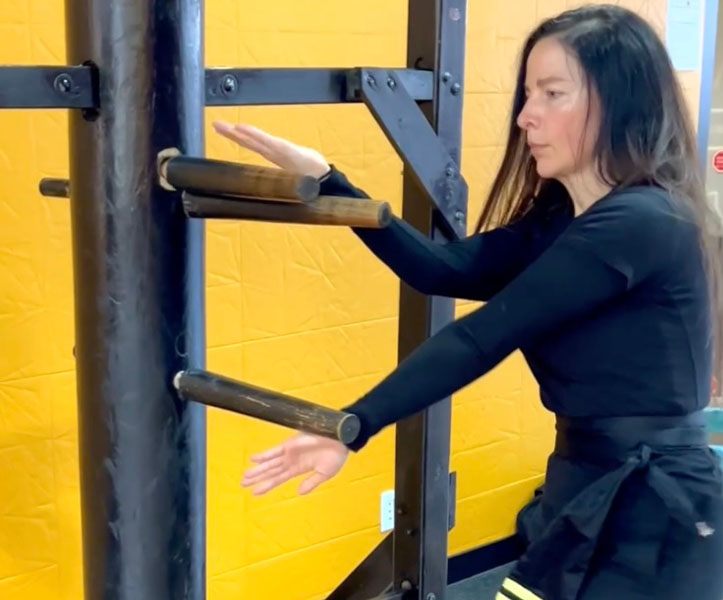
The classic dummy hangs between two horizontal slats held in a frame, or sits in a pit in the ground in older setups. The slats give the dummy a little spring when struck, which is part of how it is meant to feel. A frame-mounted dummy can stand in a garage, basement or training room without being fixed to the wall, but the frame takes up floor space and needs to be heavy or anchored so it doesn't walk across the floor.
Wall-mounted
A wall-mounted dummy hangs on brackets or slats fixed to the wall. It saves floor space and is the most common choice for home students. The trade-off is that the wall takes every impact. You need solid fixings into masonry or framing, and you need to think about noise carrying through to the next room or the neighbours.
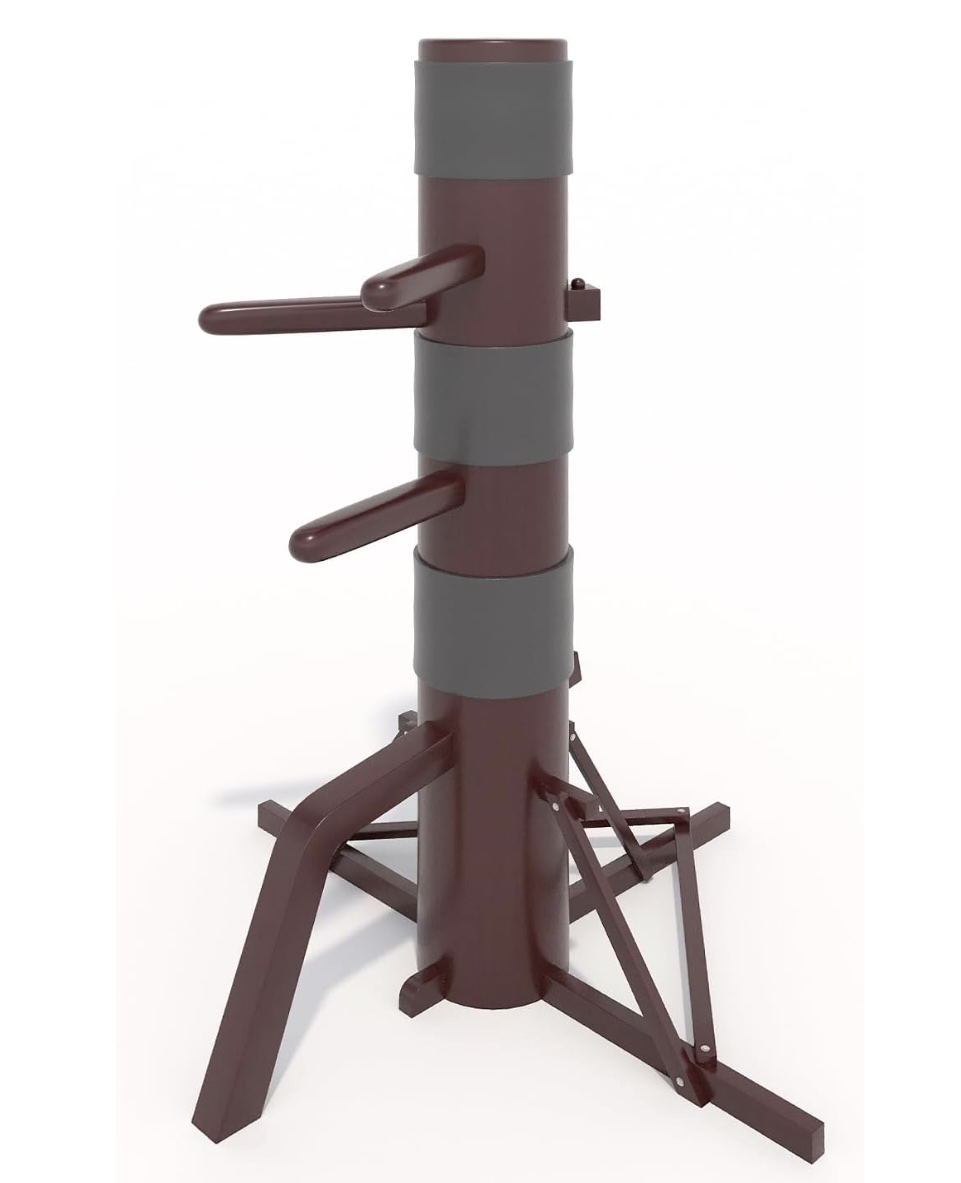
Free-standing base
These sit on a weighted or wide base with no wall or ceiling fixing. They are the easiest to move and suit renters, but even a heavy base can rock or shift under hard training. Look at how the base is weighted, whether it can be bolted down later, and how much spring (if any) the design allows.
Budget and compact dummies
Some dummies use a shorter body, fewer parts or lighter materials to save money and space. They can be perfectly useful for learning the sequence and angles. Check that the arm and leg positions are still realistic, because a dummy that is the wrong height or has arms at odd angles will teach you the wrong positions.
DIY dummies
Many students build their own. The body can be a hardwood log, laminated timber or even a sturdy post, with arms cut from dowel or hardwood. The difficult parts are drilling the arm and leg holes at accurate angles and building a mount strong enough to take years of striking. Sifu Kendra Mahon covers this on her own blog in how to build a wooden dummy.
Materials
The body and arms take the most punishment, so material choice matters more than finish.
- Dense hardwood bodies feel solid and traditional and resist dents. They are heavy, which helps stability but makes shipping and mounting harder.
- Softer or lighter woods are cheaper and easier to handle, but may dent, split or wear faster at the arm holes.
- Laminated bodies glue several pieces together. Done well, they resist cracking; done badly, seams can open over time. Look closely at the glue lines.
- Synthetic or padded bodies are quieter and gentler on the forearms but give a different, softer feel.
- Arms and leg should be hardwood that won't snap. Check the grain runs along the arm rather than across it, and that the fit in the body is snug without forcing.

Arm and leg configuration
A standard Wing Chun dummy has two upper arms set at an angle, one middle arm below and between them, and one leg angled towards you. Heights and angles differ between lineages and makers, and that is the point to check most carefully.
- Ask your instructor what heights and angles your lineage uses, and compare them to the product before buying.
- Check whether the dummy can be mounted at an adjustable height. Being able to raise or lower it for your own height is a real advantage.
- Make sure the leg is long and strong enough for the kicking and stepping work in your form.
- Arms that wobble in their holes, or that need to be hammered in, are both warning signs.
Space and mounting
You need room to circle the dummy, not just stand in front of it. Measure the space before you start comparing models: allow clearance on both sides for the side steps and angle changes in the form, plus room behind you to step back. A garage, basement or spare room usually works better than a living room.
For wall mounting, find out what your wall is made of and use fixings rated for repeated impact, not just static weight. For frames, check the floor footprint and whether you can anchor or weight the base. If you rent, ask before drilling. Our home training setup guide covers floor and space planning in more detail.
What to check before you buy
Pre-purchase checklist
- Does the arm and leg layout match what your instructor teaches?
- Can it be mounted where you actually plan to train, and is that wall or floor strong enough?
- Is the height adjustable, or can the mount be placed at the right height for you?
- What is the body made of, and are there cracks, open seams or knots near the arm holes?
- Do the arms fit snugly and come out cleanly for storage or replacement?
- Is the mount or frame included, or sold separately?
- How heavy is it, and can you physically get it into the room?
- Is there a returns policy if it arrives damaged?
Maintenance
A well-looked-after dummy lasts a very long time. Keep it away from damp, radiators and direct sun, because swings in humidity are what crack wooden bodies. Check bolts, brackets and wedges every few weeks, since impact loosens them gradually. When bare wood starts to look dry or rough, treat it with a suitable wood oil or finish and let it cure before training again. Replace a cracked or splintered arm rather than training on it; a failing arm can snap under load.
Alternatives if you can't have a dummy
Plenty of students train the dummy form for a long time before they own one. The form can be learned and drilled in the air with floor markers and a camera, which builds the sequence, footwork and structure; see training the dummy form without a dummy. A wall bag adds contact for straight strikes, and a partner holding focus mitts can feed angles. None of these fully replace the dummy, but together they cover a great deal of what it teaches.
For a longer discussion of dummy types, see my post best Wing Chun wooden dummy on my blog. If you are learning online, the dummy form is taught within the Kung Fu Kendra Wing Chun Online Certification Course; compare any course using our course checklist.
Frequently asked questions
Do I need a wooden dummy to learn Wing Chun?
No. Beginners need instruction, floor space and a way to check their structure. The dummy becomes useful once you are learning the dummy form or want contact feedback for angles and footwork. You can learn the form in the air first.
What type of wooden dummy is best for an apartment?
A wall-mounted dummy on a properly anchored frame, or a compact free-standing unit with a wide, heavy base, is usually the most practical. Check whether your walls can take the load and whether impact noise will bother neighbours before buying.
Is a solid hardwood body better than a softer wood?
Dense hardwood bodies tend to resist cracking and feel more traditional, but are heavier to ship and mount. Softer woods and synthetic bodies are lighter and quieter but can dent or wear faster. Choose based on your mounting, how hard you train and how much maintenance you will do.
Can I build my own wooden dummy?
Yes, many students do. The hard parts are drilling the arm and leg holes at the right angles and building a frame or mount that is strong enough. Get the measurements from your instructor so the dummy matches your lineage.
How do I look after a wooden dummy?
Keep it out of damp and direct heat, check the bolts and wedges regularly, and treat bare wood with a suitable oil or finish when it starts to look dry. Replace a cracked arm rather than training on it.
Next: rings and wall bags · home training setup · all gear guides