
The short answer
Yes, you can genuinely learn Wing Chun online, as long as you choose a structured course, train consistently, and are honest about what video can and can't replace.
Can you really learn Wing Chun online?
Wing Chun is a close-range art built on structure and touch: Chi Sao, the pressure of an opponent's arm, the feel of correct alignment. It's fair to ask how a screen could teach that.
The honest answer is that it can't teach all of it. But good online courses aren't trying to replace a teacher's hands on your elbow. They build the foundation: fluency in the forms, sound structure, footwork, and an understanding of why Wing Chun works the way it does. That foundation lets you progress quickly, whether you later join a school, attend seminars, or keep training at home.
For many people, online training is also the only realistic option. Plenty of towns have no Wing Chun school at all, and some that do don't teach the lineage a student is looking for. Kendra has written more on this in Can Wing Chun be learned online?
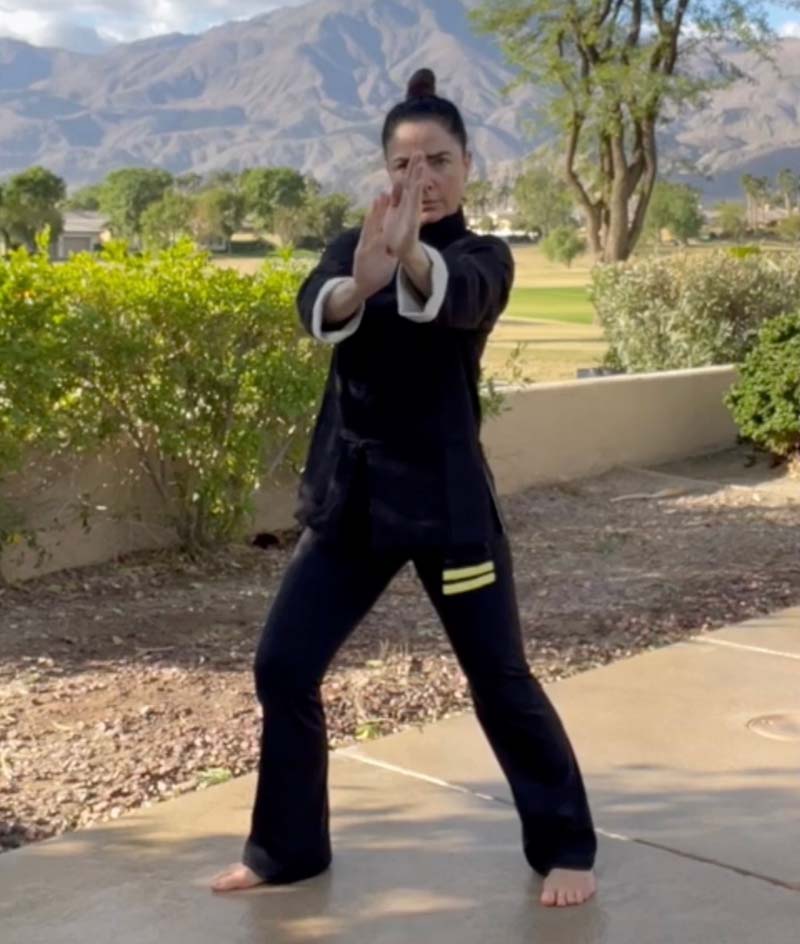
What trains well online, and what's harder
Trains well from video
Sil Lim Tao, Chum Kiu and Biu Jee forms; stance and structure; centreline theory; footwork; striking mechanics; wooden dummy sequences; the strategy behind the system.
Harder without a partner
Chi Sao (sticky hands), sparring, sensitivity to pressure, reaction timing, and reading a resisting opponent. These need a partner at home or periodic in-person work.
The good news is that most of the Wing Chun curriculum can be trained solo: the three empty-hand forms, the wooden dummy form, footwork and striking. That's a great deal of material for any beginner. For the partner-based side, read Kendra's post on whether Chi Sao can be learned online.
Getting started, step by step
Step 1: Understand the lineage landscape
Wing Chun isn't one single system. After Grandmaster Ip Man taught in Hong Kong, the art branched through his sons and through students such as William Cheung and Wong Shun Leung, and older branches like the Leung Jan line continue too. Within the teaching of Grandmaster William Cheung there are two distinct lines: some schools teach mainstream Wing Chun, others teach Traditional Wing Chun.
Each branch has its own emphasis. Spend some time on our lineages guide before you choose, so you know what you're signing up for.
Step 2: Make a training space
You don't need a gym. A clear area of floor about two metres square is enough for forms and footwork. Good light matters if you plan to film yourself. Our home training setup guide covers the basics, and when you're ready for equipment, see the gear guides, including rings and wall bags.
Don't have a wooden dummy? You don't need one yet. See how to train wooden dummy work without a dummy.
Step 3: Choose a structured course, not a playlist
Free videos are good for getting a feel for the art, but they make a poor main teacher. Without a structured path, students piece together instruction from different lineages, pick up conflicting habits, and stall. Look for a defined syllabus, clear levels, and an instructor who is accountable for your progress.
Our seven-point course checklist explains exactly what to check before paying. Use it on every course you look at, including Kendra's own program, the Kung Fu Kendra Wing Chun Online Certification Course.
Step 4: Set your routine before day one
Consistency beats intensity. Several short sessions a week will usually serve you better than one long one, because structure is built through repetition. Decide on your training days and times before you start, and treat them like a class you've paid to attend. Kendra's first 30 days guide offers a starting structure.
Step 5: Film yourself and review it
Recording your practice is one of the most useful habits an online student can build. Film your form from the front and the side, then compare it carefully with your instructor's demonstration. You'll spot problems you can't feel. If your course offers video review, send your recordings in; if not, your own review still helps.
Common beginner mistake: rushing through forms just to "finish" them. Wing Chun rewards depth over breadth. Getting your Sil Lim Tao structure right before moving on to Chum Kiu will save you a lot of re-correction later. Experienced practitioners keep returning to the first form for the whole of their training. Kendra's guide to the first form is a good place to start.
What to look for in your first course
- A clear level-by-level progression, not a pile of unsorted videos.
- An instructor whose lineage you can check.
- A thorough breakdown of Sil Lim Tao as the foundation.
- Explanation of the principles behind each movement.
- Some form of feedback: video review, live sessions or a qualified coach.
- A total price you can work out up front.
- A clearly written refund policy.
How long will it take?
That depends on your goals, how often you train, and how a course is structured. Rather than trusting a headline timeframe, ask each course how many levels it has and what you need to demonstrate to pass each one. That tells you far more about the real journey. Students who train online should be especially deliberate about self-review and, where they can, about getting hands-on time with a partner or at seminars.
Is online Wing Chun worth it?
If you don't have a good school nearby, online training isn't a compromise; it's the most practical way in. Even students with a local school often add an online course for the extra explanation, the ability to rewatch lessons, or access to a lineage they can't find locally.
For a wider view of how this shift happened, read how the digital era is changing martial arts learning. When you're ready to compare options, start with our learning guides and read real experiences on Student Reviews.
Frequently asked questions
Can you really learn Wing Chun online?
You can learn a large part of it: the forms, stance, structure, footwork, striking and wooden dummy work all train well from good video instruction. Chi Sao and live pressure need a partner, so plan for a training partner, seminars or occasional in-person work.
How much space do I need to train at home?
A clear patch of floor about two metres by two metres is enough for forms and footwork. Good lighting helps if you plan to film yourself, which you should.
How often should a beginner train?
Short, regular sessions beat occasional long ones. Several sessions of around half an hour a week will usually do more for you than a single long session, because Wing Chun structure is built through repetition.
Do I need a wooden dummy to start?
No. The wooden dummy comes later in most curricula. You can begin with the first form and footwork, and even practise dummy-style drills without one. See our guide to training without a dummy.
How long does it take to learn Wing Chun online?
It depends on your goals, how often you train and how the course is structured. Ask any course how many levels it has and what you must demonstrate at each one, rather than relying on a headline timeframe.
Is YouTube enough to learn Wing Chun?
Free videos are useful for exposure, but they rarely give you a structured path or any feedback, and mixing teachers from different lineages can leave you with conflicting habits. Use them alongside a structured course rather than instead of one.