
The goal is to get home safely
Before any technique, let’s agree on the goal. Self-defense is not about winning a fight. It is about getting yourself, and the people with you, to safety. If you can walk away, that is always the best outcome. If you cannot, you use only what you need, for as long as you need it, to create a chance to escape.
Wing Chun fits this mindset well. It is a defensive system that aims to end a threat quickly so you can leave, not to win a contest. I often say that a true fight won is one that never started. Everything below is arranged in the order you should use it: awareness, avoidance, de-escalation, and only then physical skill.
Layer 1: Awareness
Most of self-defense is noticing things early. The earlier you see a problem, the more options you have.
- Keep your head up. Phones and headphones take away the few seconds of warning you would otherwise get.
- Notice exits. When you enter a room, a car park or a train, note where you could leave.
- Watch for changes. Someone who keeps closing distance, circles behind you, or whose behaviour suddenly shifts is worth paying attention to.
- Trust your instincts. If something feels wrong, you do not need proof to cross the street, change carriages or go back inside.
Layer 2: Avoidance
Avoidance means acting on what awareness tells you. Leave early. Choose the well-lit route. Do not argue with someone who is clearly looking for trouble. Keep distance, because distance gives you time, and time gives you options. None of this is cowardice. It is the most effective self-defense there is.
Layer 3: De-escalation
If someone confronts you, your voice and body language can often calm things down or buy you space to leave.
- Keep your hands up and open, at chest height, palms forward. It looks calm and non-threatening, and it also puts your hands between you and the other person.
- Speak clearly and firmly. “Stop.” “Back off.” “I don’t want any trouble.” Short phrases are easier to say under stress and draw attention from others.
- Don’t match their energy. Insults and posturing are invitations to escalate. You do not need to win the argument.
- Keep moving toward an exit or toward other people while you talk.
A note on the law. Self-defense laws differ from country to country and often between regions within a country. Learn what applies where you live, including what counts as reasonable force and any duty to retreat. Nothing on this page is legal advice.
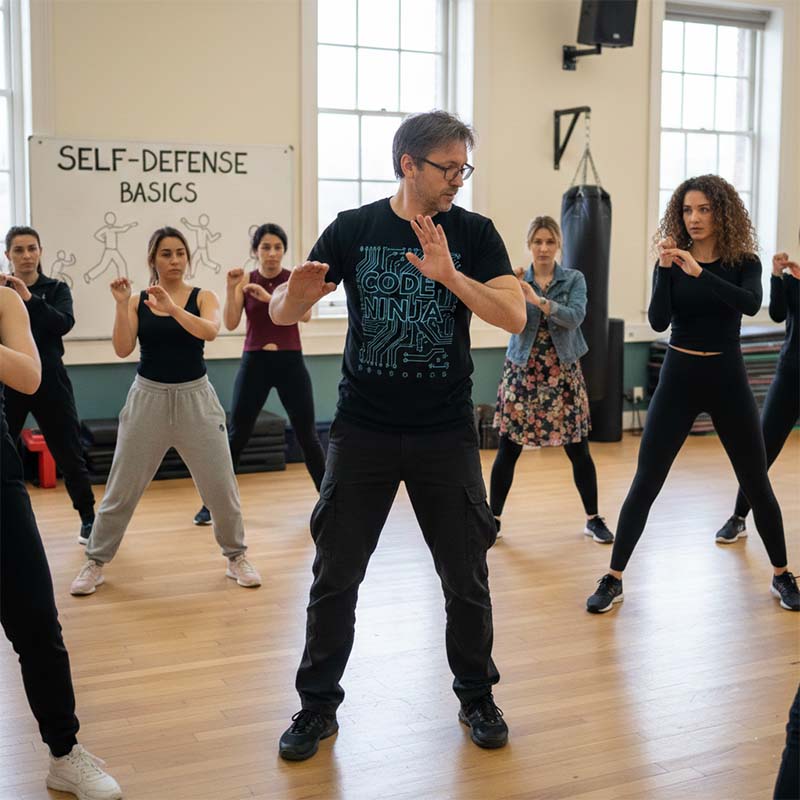
Layer 4: What Wing Chun does well at close range
When distance has gone and you cannot leave, Wing Chun’s design starts to matter. Most real confrontations happen very close, where there is no room to wind up big techniques. Wing Chun was built for exactly that space.
- Centerline focus. Your guard protects your own centre and your strikes travel straight to theirs, the shortest path. See centerline theory.
- Simultaneous defense and attack. Instead of blocking and then hitting, Wing Chun does both at once, for example a Pak Sao clearing an arm while the other hand strikes. See Wing Chun hand techniques.
- Structure over strength. Power comes from alignment and forward intent rather than muscle, which is why Wing Chun suits smaller people. The Wing Chun punch lesson shows how.
- Getting off the line. In Traditional Wing Chun we pick up our feet and step on angles, moving off the line of attack while staying in position to strike. You do not stand in front of the force.
- Sensitivity by touch. At close range things happen too fast to watch. Chi Sao trains you to feel where pressure is coming from and respond through contact.
- Low kicks. Wing Chun kicks are kept low and direct, so they can be used up close without sacrificing balance. See Wing Chun kicks.
The purpose of all of this is the same: interrupt the attack, create an opening, and leave. Use technique only as long as you need to get away safely.
Honest limits
Every martial art has gaps, and pretending otherwise is dangerous. Here is what I tell my students about Wing Chun:
- The ground. Wing Chun is mainly a standing system with limited ground work. Its footwork and structure help you avoid being taken down, but if grappling worries you, some basic grappling awareness gives you a more complete picture. My post Wing Chun vs MMA talks about this.
- Size and strength still matter. Good structure narrows the gap, but it does not erase it. That is one more reason awareness and avoidance come first.
- Multiple attackers. Any physical encounter with more than one person is extremely dangerous. Positioning and escape matter far more than technique.
- Weapons. No unarmed method makes facing a weapon safe. If someone wants your property, give it to them. Possessions can be replaced.
- Untested skill. Techniques you have only practised in the air or cooperatively will not hold up under stress. Skill has to be trained against resistance to become reliable.

Training for pressure
Real situations bring adrenaline, fear and confusion. Your body will not suddenly perform better than you have trained it, so the aim is to bring a little of that pressure into practice, safely and gradually.
- Build the foundation. Everything starts with structure. Sil Lim Tao teaches you to hold correct alignment while relaxed, so your techniques work when you are stressed.
- Learn cooperatively first. Drill each technique slowly with a partner who gives you a clear, predictable attack. See partner drills.
- Add resistance gradually. Increase speed, add a little unpredictability, then controlled resistance. Change one variable at a time.
- Start from bad positions. Practise responding when your hands are down, when you are turned slightly away, or when you are already being pushed.
- Train tired, sometimes. A short bout after some light conditioning shows you what happens to your structure under fatigue. The conditioning lesson has ideas.
- Rehearse the whole sequence. Include the voice, the open-hand fence, the response and the exit, not just the technique in the middle.
Practice plan: one session a week for pressure
- 5 minutes: warm-up and slow Sil Lim Tao for structure.
- 10 minutes: cooperative partner drill, such as Pak Sao with a straight punch, at walking pace.
- 10 minutes: the same drill with your partner varying timing and side, at moderate speed.
- 5 minutes: scenario practice. Your partner walks toward you talking; you use your voice and open hands, then respond if they reach, and finish by moving to an “exit” marker.
- 5 minutes: talk it through and note one thing to fix.
Safety: wear suitable protection (see protective gear), agree on a stop word, never strike the eyes, throat or groin with real intent in training, and keep contact controlled. If you have a health condition or injury, check with your doctor before adding intensity.
Who Wing Chun suits for self-defense
Because Wing Chun does not rely on size or strength, it has long been valued by women, smaller people and older students. Confidence tends to grow alongside skill, and that confidence changes how you carry yourself, which itself makes you a less likely target. If that applies to you, see Wing Chun for women and Wing Chun for older adults, and my post on Wing Chun self-defense for women.
For my shorter answer to the big question, read is Wing Chun good for self-defense? on my blog. If you want structured feedback on your technique, my online course has graded video exams at each of its 10 levels, but whatever you choose, find a training partner and test what you learn.
Frequently asked questions
Is Wing Chun good for self-defense?
Yes, with context. Wing Chun was built for close-range, real-world situations rather than sport, and it relies on structure, timing and angles rather than size. Like any art, it only works if you train it consistently and test it against resistance.
What is the most important self-defense skill?
Awareness. Noticing a problem early gives you the chance to leave, keep your distance or talk the situation down before anything physical happens. Technique is the last layer, not the first.
Does Wing Chun work on the ground?
Wing Chun is mainly a standing system with limited ground work. Its footwork and structure help you avoid being taken down, but if you are concerned about grappling, adding some basic grappling awareness gives you a more complete picture.
How long before I can use Wing Chun to protect myself?
Awareness, distance and a few simple tools can be useful within the first months of consistent training. Making techniques reliable under stress takes longer and depends on how regularly you train with resistance.
Can Wing Chun help against a weapon?
No unarmed method makes facing a weapon safe. If someone has a weapon and wants your property, give it to them. If you cannot get away, your aim is to protect yourself only as long as it takes to escape, and that should be trained under qualified supervision.
Next: the philosophy of Wing Chun · partner drills · Chi Sao explained · all lessons