
What the centerline is
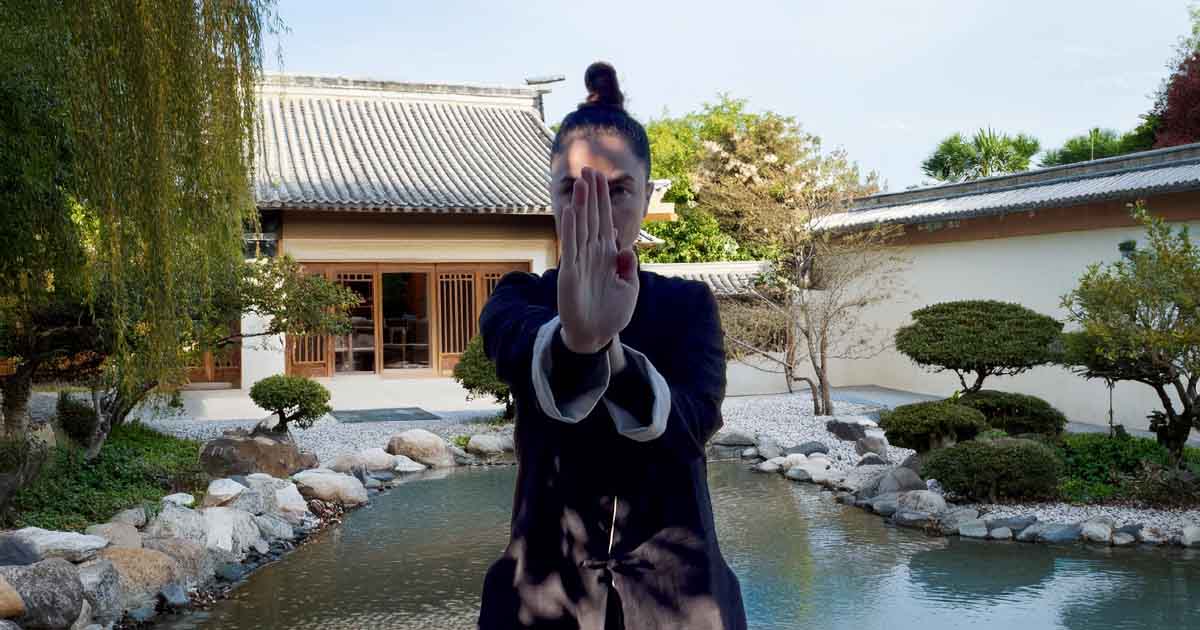
Imagine a vertical line running from the top of your head, down through your nose, throat and breastbone, to your groin. That is your centerline. Your opponent has one too. The most vulnerable targets on the body sit on or close to it: the eyes, nose, throat, solar plexus and groin.
Centerline theory is the strategic idea underneath all of Wing Chun. Put simply: protect your own centerline, control and attack your opponent's. Once that clicks, the shapes of the system stop looking strange. The hands sit in front of the body rather than beside it because that is where they guard the line. The punch travels straight because that is the shortest path along it.
Why the centerline matters
It is the shortest path
Between two people facing each other, the straightest line between them runs from centerline to centerline. A strike along that line has the least distance to travel, so it arrives first. This is economy of motion in its purest form; see the core principles of Wing Chun for how it connects to the others.
It holds the targets
Because the vulnerable points sit on the centerline, controlling it means you are always threatening something that matters, and guarding it means you are protecting what matters most.
It organises your structure
When your hands and elbows stay close to the line, force travels through your body in a straight, connected way. That is why centerline and structure are taught together from the first lesson.
Occupy, clear, attack
Every Wing Chun hand technique does one of three jobs on the centerline:
- Occupy it. Your guard hands sit on the line, one in front of the other, so an opponent's straight attack runs into your arm before it reaches you. Wu Sao, the guarding hand, is the classic example.
- Clear it. If something is blocking the line, such as the opponent's arm, you remove it. Pak Sao slaps it aside, Lop Sao pulls it away, and the other hand strikes through the gap.
- Attack along it. The punch, the palm strike and the finger strike all travel straight down the line to the target.
You will see each of these jobs in the hand techniques lesson.
The immovable elbow
Your hands follow your elbows. If the elbow stays down and in, close to the centerline, the hand stays on the line and the arm is strong. If the elbow flares outward, the technique loses strength and the centerline opens. This is called the immovable elbow principle, and drifting elbows are one of the most common errors I correct.
There is one deliberate exception. Bong Sao raises and rotates the elbow, and it is the only Wing Chun technique that doesn't follow the elbow-on-the-centerline rule. That is part of why it is used as a response when you are under pressure, not as your first choice.
A useful bonus of watching elbows: a punch can be disguised, but the elbow can't hide what is coming. Watching your opponent's lead elbow helps you read an attack early.
Centerline, angles and facing
This is where lineages differ, so it is worth being clear. Some schools teach mainstream Wing Chun, where students often square up and fight straight down the centerline. Others teach Traditional Wing Chun, the line of Grandmaster William Cheung, which I teach as it was passed down to me by Master Brian Lewadny, who learned it from Grandmaster William Cheung.
In Traditional Wing Chun we still use the centerline, but we don't stand in front of both of the opponent's weapons. We lift the feet and step on an angle, often to the outside of the opponent's lead arm, the blindside, and then turn so that our centerline faces theirs while theirs no longer faces us. The idea is simple: why stand where they can hit you, when you can step to where they can't?
This is what the principle of facing means. Your centerline points at the opponent's centerline, so both your hands are available, and your footwork decides from which angle you do it. The pivot and stepping in Chum Kiu are where this is trained. My blog post on Traditional vs mainstream Wing Chun covers the differences in more depth.
Drills to train the centerline
Drill 1: Mirror line
Stand in your stance in front of a full-length mirror. Imagine a line down the middle of your reflection; a strip of removable tape on the mirror helps. Raise your guard so both hands sit on the line, one in front of the other, elbows down. Hold for thirty seconds, then lower and raise again. Ten times. You are teaching your hands where "home" is.
Drill 2: Doorway punches
Stand facing an open doorway or a wall corner so the vertical edge lines up with your nose. Throw slow straight punches, alternating hands, and check that each fist travels along the edge without drifting sideways. Keep the elbow down and behind the fist. Twenty punches, slowly.
Drill 3: Elbow check
In your guard, perform slow Tan Sao, Fook Sao and Wu Sao on each side. After each one, freeze and look at your elbow. Is it down and roughly a fist's distance from your body? Or has it floated out? Correct it, relax, and move on. Five of each per side.
Drill 4: Chair angles
Place a chair a step or two in front of you as a target. From your stance, take a small angled step forward and to one side, lifting the foot rather than sliding, then turn to face the chair's centre with your guard on its line. Step back to the start and repeat to the other side. Never cross your feet. Ten each way.
Drill 5: Partner line (optional)
If you have a partner, ask them to stand in a guard while you slowly bring a straight punch toward their chest, stopping well short. They should not need to move their hands far to meet it, because their hands are already on the line. Swap roles. Go slowly, no contact to the face, and agree on intensity before you start; the partner drills lesson has more safety guidance.

Try this: 15-minute centerline session
- Warm up the shoulders, wrists and hips (3 min).
- Mirror line, ten raises (2 min).
- Doorway punches, twenty slow (3 min).
- Elbow check, five of each technique per side (4 min).
- Chair angles, ten each way (3 min).
Do this three or four times a week alongside your Sil Lim Tao. Train within a comfortable range of motion, and check with your doctor first if you have a joint, heart or other health condition.
Common centerline mistakes
- Hands too wide. Guard hands drifting to the sides of the body leave the line open. Bring them back in front of you.
- Elbows flaring. Check the immovable elbow every time you freeze in a position.
- Chasing the opponent's hands. Your target is the centerline, not their arms. Deal with an arm only if it is in the way.
- Leaning to reach. If you can't reach the line, step. Leaning breaks structure.
- Standing flat in front of the attack. In Traditional Wing Chun, step on an angle and then face.
- Turning too far side-on. If one hand can no longer reach the opponent's centerline, you have over-turned.
Where to go next
Centerline theory is one of the first things I teach because everything else hangs on it. Once you can find the line without thinking, move on to the Wing Chun punch and chain punching, and later to Chi Sao, where you learn to keep the centerline under live pressure. For more on how the centerline appears across Wing Chun terms, see my Wing Chun glossary, and for footwork, Wing Chun footwork.
If you are training at home, the home training setup guide covers mirrors and floor space. And if you want someone to check your line and elbows on video, my online course includes graded video exams at every level.
Frequently asked questions
What is the centerline in Wing Chun?
It is an imaginary vertical line running from the top of the head down through the middle of the body. The most vulnerable targets, including the eyes, nose, throat, solar plexus and groin, sit on or near it. Wing Chun protects your own centerline while attacking your opponent’s.
Why does Wing Chun punch along the centerline?
A straight line is the shortest path to the target, so a punch from the centerline arrives quickly and is hard to see coming. It also keeps your own centerline covered while you strike, because your arm travels along it.
What is the immovable elbow principle?
It means keeping the elbows down and in, close to your centerline, rather than letting them flare outward. When the elbows drift out, techniques lose strength and the centerline opens. Bong Sao is the one technique where the elbow deliberately rises.
Does Traditional Wing Chun stand square in front of the opponent?
No. Traditional Wing Chun uses angled stepping to get off the line of attack, often to the outside of the opponent’s lead arm, then turns to face their centerline from there. Some schools teach mainstream Wing Chun with a more square approach; both use the centerline.
How can I practise centerline theory alone?
Use a mirror, a doorway or a wall corner to check that your punches and hand positions travel straight along the line. Sil Lim Tao, slow punching drills and angled stepping drills with a chair as a target all train it without a partner.
Next: the Wing Chun punch · hand techniques · core principles · all lessons