
Start with comfortable clothing
For your first weeks, and for most home training, ordinary exercise clothes are perfect. What matters is that nothing restricts your stance, your arms or your breathing, and nothing gets in the way of good structure.
- Trousers: loose or stretchy training trousers that let you bend your knees, step and kick without pulling. Avoid jeans and anything tight across the hips or knees.
- Top: a T-shirt or light, breathable top. Sleeves should not be so loose that they hide your elbow position or catch on a partner’s hands.
- Layers: a light layer for warming up, especially if you train in a cool garage or outdoors. Take it off once you are warm.
- Support: a supportive sports top or athletic underwear makes stepping and chain punching more comfortable.
If you train online, there is one extra consideration: your clothes should let you see your structure on camera. Very baggy clothing hides your knees, hips and elbows, which makes it harder for you, or a teacher, to spot mistakes. Something reasonably fitted, in a colour that contrasts with your background, makes filming much more useful. My home training setup guide covers camera and lighting.
Before partner training
- Remove rings, watches, bracelets and earrings. They scratch partners and can catch during Chi Sao.
- Keep fingernails short and smooth.
- Tie back long hair so it stays out of your eyes and your partner’s hands.
- Wear clean clothes. Close-range training means you are very close to each other.
Kung fu uniforms
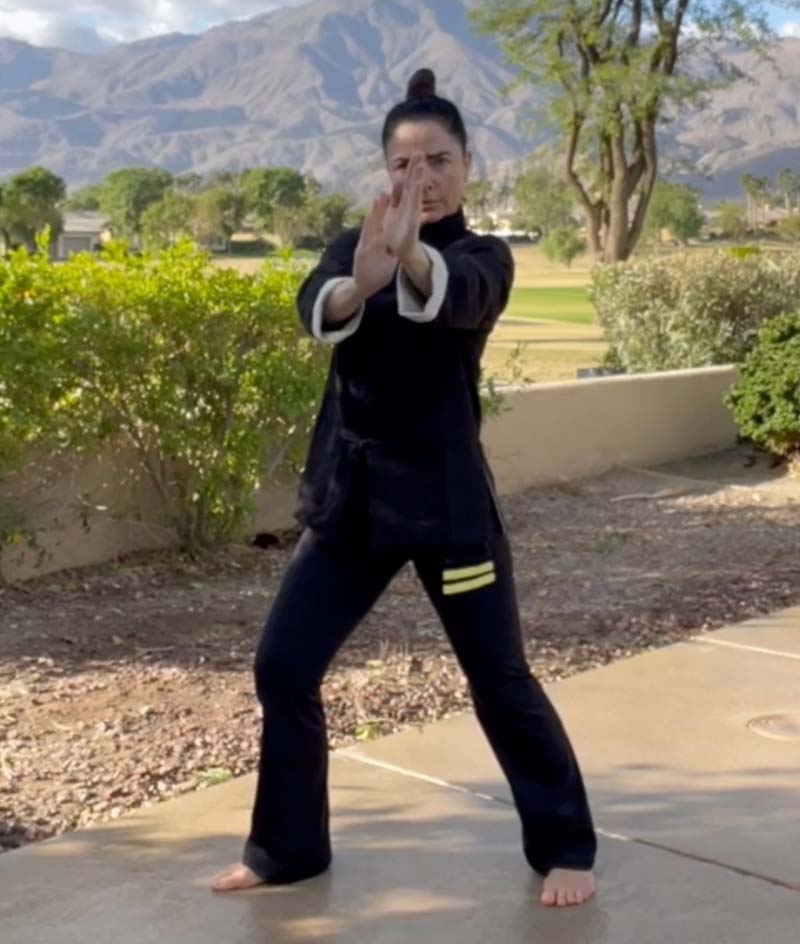
Many Wing Chun schools use a uniform, and wearing one can help you feel ready to train. The most familiar style is a traditional Chinese jacket fastened with knotted cloth buttons, worn with loose trousers. Plenty of schools prefer something simpler: a school T-shirt with plain black training trousers.
If you are joining a school, ask what they use before you buy anything. They may have a set style or colour, and you do not want to buy twice. If you train at home, a uniform is optional. Some students like having one because putting it on is a signal to the mind that training has begun.
What to look for in a uniform
- Freedom in the shoulders. Raise both arms forward to shoulder height and turn your body. The jacket should not pull across your back.
- Room in the seat and knees. Sit into your stance and step forward. The trousers should not tighten or ride up.
- The right length. Trouser hems should clear your heels so you do not step on them while turning, and sleeves should end around the wrist so they do not cover your hands.
- Fabric. Cotton is breathable and comfortable but can shrink, so allow for that when choosing a size. Blended fabrics are often more durable, dry faster and hold their shape. Choose what suits your climate and how much you sweat.
- Secure fastenings. Buttons and ties should stay closed through stepping and turning without needing constant adjustment.

The sash and what its colours mean
Wing Chun has no single, universal ranking system. Ranks vary by lineage and by organisation, and some schools have no formal ranks at all. So a sash colour on its own tells you very little unless you know which system it belongs to.
In Traditional Wing Chun, the line of Grandmaster William Cheung in which I teach, rank is shown with a sash rather than a belt (though many people say “belt”). As I explain in my post on the Traditional Wing Chun ranking system, the structure is:
| Sash | Rank | What it marks |
|---|---|---|
| Black sash with gold bars | Levels 1 to 9 | Every student begins with a plain black sash; a gold bar is added as each level is completed, through stance, structure, the empty-hand forms and Chi Sao fundamentals. |
| Solid gold sash | Level 10 | Instructor Level: enough command of the system to begin teaching. Further development is marked with bars on the gold sash. |
| Red sash | Advanced instructor | Earned after further years of training and teaching. |
| Purple sash | Master Level | The top of the system, for those who have devoted most of their martial arts life to Traditional Wing Chun and to passing it on accurately. |
You can read more about the top rank in my post on the purple sash master level, and about how levels work in the ranks and levels lesson.
Sash etiquette
- A sash is earned, not bought. Wear the colour your teacher has awarded you through grading.
- Learn to tie it from your school. The way a sash is tied and worn varies between schools, so ask your instructor to show you.
- Treat it with respect. Fold it and keep it off the floor. It represents your work and your lineage.
- Training alone? If you are not graded, simply train in comfortable clothes. There is nothing wrong with that; your skill is what matters.
Shoes: flat, thin and grippy
Wing Chun depends on a stable stance and precise footwork. You step on angles, turn and shift your weight constantly, and your feet need to feel the ground to do that well. My general advice is simple: flat, grippy footwear or bare feet, and avoid thick soles.
What to look for
- A flat sole with no raised heel, so your weight sits naturally and your stance is not tipped forward.
- A thin, flexible sole, so you can feel the floor and your balance.
- Enough grip, but not too much. You need traction to step without slipping, but a very sticky sole can make turning awkward and strain the knees. Test it with a few slow turns.
- A secure fit, so your foot does not slide inside the shoe when you step.
- Light weight, so your low kicks stay quick and accurate.
Common options
- Traditional kung fu shoes: light canvas or cloth uppers with thin rubber soles. Many practitioners like them for their floor feel.
- Flat trainers or martial arts shoes: a good choice if you need a little more support or train on rough surfaces.
- Bare feet: excellent on a clean, safe, non-slip floor. Check for splinters and hazards first.
What to avoid
- Thick, heavily cushioned running shoes, which lift you off the floor and make you less stable.
- Raised heels of any kind.
- Socks on smooth floors; they slip easily when you step or turn.
- Worn-out shoes with smooth soles.
If you are an older student or have foot, ankle or knee concerns, choose flat shoes with a little more support, and check with your doctor or a physiotherapist if you are unsure. See Wing Chun for older adults for more.
Try this: the footwear test
- Stand in your stance and close your eyes for ten seconds. Can you feel where your weight sits?
- Step forward and back on angles a few times. Does anything slip or catch?
- Do a few slow turns. Do your feet move smoothly without twisting your knees?
- Try the same on bare feet if your floor is safe, and compare.
Caring for your training clothes
Follow the care label. Washing cotton in cool water and air drying helps reduce shrinkage and fading. Wash training clothes after each session, especially before partner work. Let shoes air out between sessions, and replace them when the soles become smooth or start to separate.
Clothes are the least of what you need. The gear guides cover what to add as you progress, and the protective gear guide explains what to wear when contact increases. If you would like a structured path with graded levels, my online course has ten levels, each with a graded exam.
Frequently asked questions
Do I need a kung fu uniform to start Wing Chun?
No. Comfortable clothes you can move freely in are all you need to begin. If you join a school, ask what they expect before buying anything, because many use a simple T-shirt and training trousers rather than a full uniform.
Can I train Wing Chun barefoot?
Yes, on a clean, safe, non-slip floor. Bare feet let you feel the ground and your balance. Avoid training in socks on smooth floors, because they slip easily when you step or turn.
What shoes are best for Wing Chun?
Flat shoes with a thin, flexible sole and enough grip to stop slipping, but not so much that you cannot turn. Traditional canvas kung fu shoes and simple flat trainers both work. Avoid thick, cushioned running shoes and anything with a raised heel.
What do the sash colours mean in Wing Chun?
It depends on the lineage. In Traditional Wing Chun, a black sash with gold bars marks Levels 1 to 9, a solid gold sash marks Level 10 (instructor), a red sash marks an advanced instructor and a purple sash marks Master Level. Other lineages use different systems or none at all.
Can I buy and wear any sash colour?
A sash is earned through grading with your teacher, not bought. Wear the colour your school has awarded you. If you train alone without grading, simple training clothes without a rank sash are the honest choice.
Next: protective gear · home training setup · ranks and levels · all gear guides